Start here
For a couple of weeks every spring, Bradford pears put on a show — clouds of white blossoms line driveways and streets all over the Upstate. The rest of the year tells a different story. These trees have a reputation for tearing themselves apart in storms, and South Carolina now treats their wild cousins as an invasive problem. If you have one in your yard around Anderson or Greenville, here's how to think clearly about whether to prune it, watch it, or take it down.
Section 01Bradford Pear vs. Callery Pear: What's the Difference?
It helps to get the names straight. "Callery pear" (Pyrus calleryana) is the species — a pear native to Asia that was brought to the United States. "Bradford" is one cultivar of that species, a particular selection bred and sold as an ornamental for its tidy shape and heavy bloom. Over the years nurseries released other Callery cultivars too, sold under names like Cleveland Select, Aristocrat, and others.
That distinction matters for two reasons. First, the structural weakness people associate with "Bradford" pears shows up across many Callery cultivars, not just Bradford. Second — and this is the bigger issue — when different cultivars grow near each other, they cross-pollinate, and that's what drives the invasive spread we'll cover below.
Section 02Why They Split in Storms and Ice
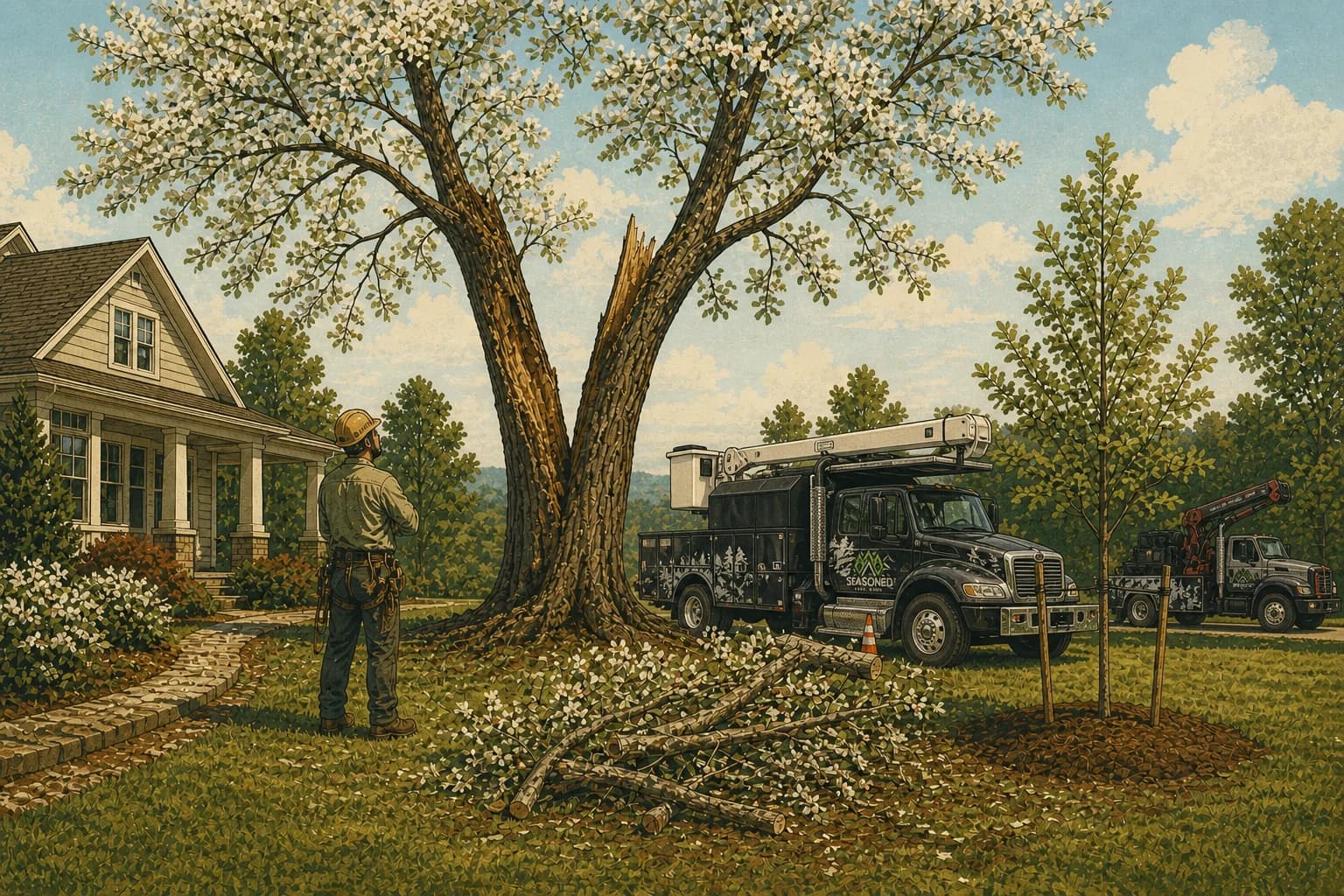
The classic Bradford pear failure isn't random. It comes from how the tree is built. Many of the major limbs emerge from nearly the same spot on the trunk and grow upward at steep, narrow angles. Where two branches press together like that, bark can get trapped inside the union instead of the wood knitting together into a strong joint. Arborists call this "included bark," and it makes the union far weaker than it looks.
Now add load. A coating of ice, wet snow, or the wind and rain of an Upstate summer storm puts serious weight on those crowded limbs. Because the branches are weakly attached and all competing for the same space, a single union can fail and take a large section of the canopy — sometimes half the tree — with it. It frequently happens when the tree is mature and largest, which is exactly when a falling limb can do the most damage to a roof, vehicle, or fence.
Tight, V-shaped unions where big limbs meet
- Why it matters
- A sign of included bark and a weak attachment point
A vertical crack or seam below a major fork
- Why it matters
- The union may already be splitting under load
A limb hanging over the house, driveway, or play area
- Why it matters
- Raises the stakes if that section fails in a storm
Past breakage or large pruning wounds with decay
- Why it matters
- Decay weakens the wood and can spread through the trunk
Thorny pear seedlings popping up nearby
- Why it matters
- Evidence the tree is contributing to invasive spread
| What to watch for | Why it matters |
|---|---|
| Tight, V-shaped unions where big limbs meet | A sign of included bark and a weak attachment point |
| A vertical crack or seam below a major fork | The union may already be splitting under load |
| A limb hanging over the house, driveway, or play area | Raises the stakes if that section fails in a storm |
| Past breakage or large pruning wounds with decay | Decay weakens the wood and can spread through the trunk |
| Thorny pear seedlings popping up nearby | Evidence the tree is contributing to invasive spread |
Section 03The Invasive Problem in South Carolina
Bradford was originally marketed as sterile, but in practice it isn't. When a Bradford pear grows within pollinating distance of a different Callery cultivar, the two can cross-pollinate and set viable fruit. Birds eat that fruit and drop the seeds across the landscape. The seedlings don't come up looking like the neat ornamental in your yard — they revert toward the wild Callery form, which is dense, fast-growing, and armed with long, hard thorns.
Those wild pears take over roadsides, fence lines, and abandoned fields, forming thickets that shade out and crowd native plants. Clemson Cooperative Extension and the SC Forestry Commission have both flagged Callery pear as an invasive concern in the state, and the SC Department of Natural Resources includes it in its broader invasive-plant resources. Clemson has also run a "Bradford Pear Bounty" program encouraging homeowners to replace these trees with native species — a sign of how seriously the issue is taken here. (We're describing the program in general terms; check with Clemson for current details.)
Section 04Pruning vs. Removal: How to Decide
It's not true that every Bradford pear has to come down today, and we won't tell you it is. The right move depends on the tree's age, structure, health, and what's underneath it.
When structural pruning may help
On a younger tree, careful pruning can sometimes set it up to grow with better-spaced, better-attached limbs and reduce the chance of a major split later. Even on an older tree, thinning and reducing heavy, overextended limbs can lighten the load that crowded unions have to carry. Pruning doesn't rebuild a weak union, but on the right tree it can buy time and lower the risk. This is the kind of work our tree trimming service is built for.
When removal is the better call
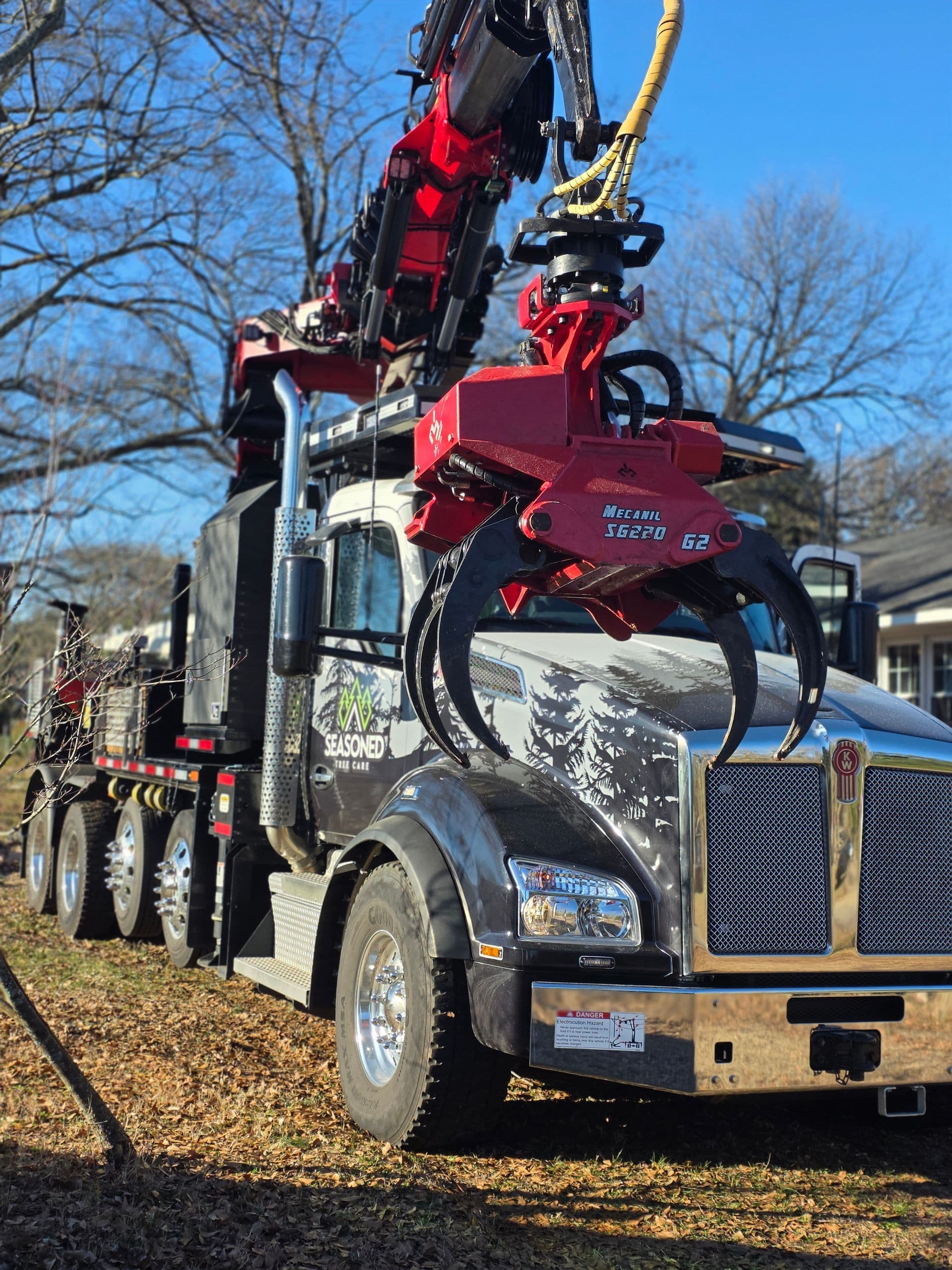
Removal tends to make sense when a tree has already started to fail — a visible split, a crack below a major fork, or a large limb that has dropped before — or when big, weakly attached limbs hang directly over your house, cars, or a space where people gather. Advanced decay, a leaning trunk, or a tree that's clearly seeding the area with thorny pear seedlings also pushes the decision toward removal. When that's the path, our tree removal crew can take the tree down safely, and for the large or tightly situated ones, we have a crane to lift sections out cleanly rather than dropping them on what's below.
After the tree is down, the stump is its own decision. Callery pear roots can sprout, so grinding the stump both stops that regrowth and clears the spot for whatever you plant next. Our stump grinding service handles that step with dedicated equipment.
Section 05What to Plant Instead
A big reason people hesitate to remove a Bradford pear is the spring bloom. The good news is you can get flowers or fall color from trees that belong here and won't spread into the countryside. Clemson HGIC points to a range of native and well-adapted alternatives suited to Upstate conditions. A few to consider:
- Serviceberry — early white spring flowers, berries for birds, and good fall color in a smaller tree
- Eastern redbud — bright pink-purple blooms along the branches before the leaves appear
- Flowering dogwood — a classic Southern understory tree with showy spring bracts
- Fringe tree — clouds of soft white blooms in late spring, native and well-behaved
- Red maple — a faster-growing native shade tree with strong fall color where you have more room
- Native oaks — a long-term shade and wildlife tree for larger yards
When you're choosing, match the tree to the spot: how much sun it gets, how much room there is for roots and canopy, and how close it sits to the house. Right tree, right place beats fast and showy every time. Clemson HGIC's plant guides are a good starting point for picking among these.
Section 06Getting It Looked At
If you're not sure whether your pear is a candidate for pruning or removal, the simplest next step is to have someone stand under it and look at the unions, the lean, and what's overhead. We're based in Honea Path and serve Anderson, Greenville, and the wider Upstate, and we carry $2 million in liability insurance plus workers' comp, so the work is covered from the start. Estimates are free.
Wondering whether your Bradford pear should be pruned or taken down? Get a free, no-pressure estimate from a local crew.
Call (864) 762-1253 for a Free Estimate →Quick answers
Frequently asked questions
Not necessarily. A young, well-structured tree in good health can sometimes be improved with corrective pruning, and a mature tree that isn't threatening a structure may simply be monitored. Removal makes the most sense when a tree already shows splitting, large included-bark unions over a target, or significant decay. The right call depends on the individual tree, so an on-site look is the best way to decide.
Most of their limbs grow from nearly the same point on the trunk at narrow angles. Bark gets pinched inside those tight unions instead of forming a strong connection, so the branches are weakly attached. Add the weight of ice or a summer storm and those unions are prone to failing — often when the tree is full-grown.
Yes. Bradford pears can cross-pollinate with other Callery pear cultivars, and the resulting fruit produces seedlings that revert to a thorny, aggressive wild form. Birds spread those seeds, and the wild pears crowd out native plants along roadsides and field edges. Clemson Cooperative Extension and the SC Forestry Commission have both highlighted Callery pear as a problem species in the state.
Native and well-adapted alternatives give you spring flowers or fall color without the invasive risk. For Upstate yards, Clemson HGIC points to options such as serviceberry, eastern redbud, flowering dogwood, and fringe tree for smaller spaces, or red maple and native oaks where you have room for a larger shade tree.
We can. Stump grinding is a separate step we handle with dedicated equipment, and it's worth doing on Callery pears because the roots can sprout. Removing the stump also clears the spot so you can plant a replacement tree.
Yes. Estimates are free across the Upstate, including Anderson, Greenville, and the surrounding communities. Call (864) 762-1253 and we'll come take a look at your tree.
Related services & areas
Sources & further reading
- Clemson Cooperative Extension HGIC — Home & Garden Information Center — Callery pear and native alternatives
- SC Forestry Commission — Invasive species guidance
- SC Department of Natural Resources — Invasive plant resources
Published by Seasoned Tree Care LLC. Serving Anderson, Greenville & communities across Upstate South Carolina. This article is general information, not a substitute for an on-site assessment.