Start here
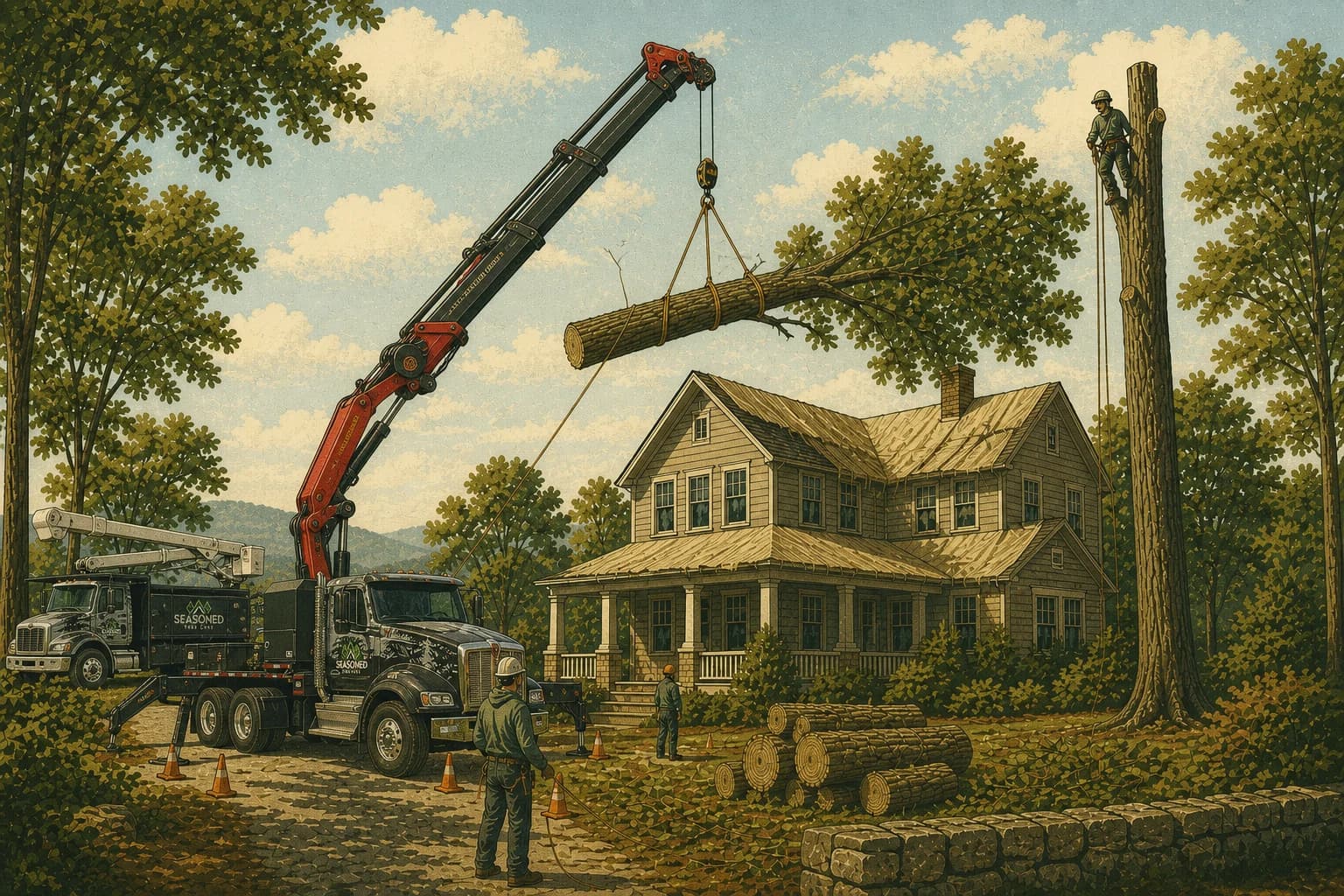
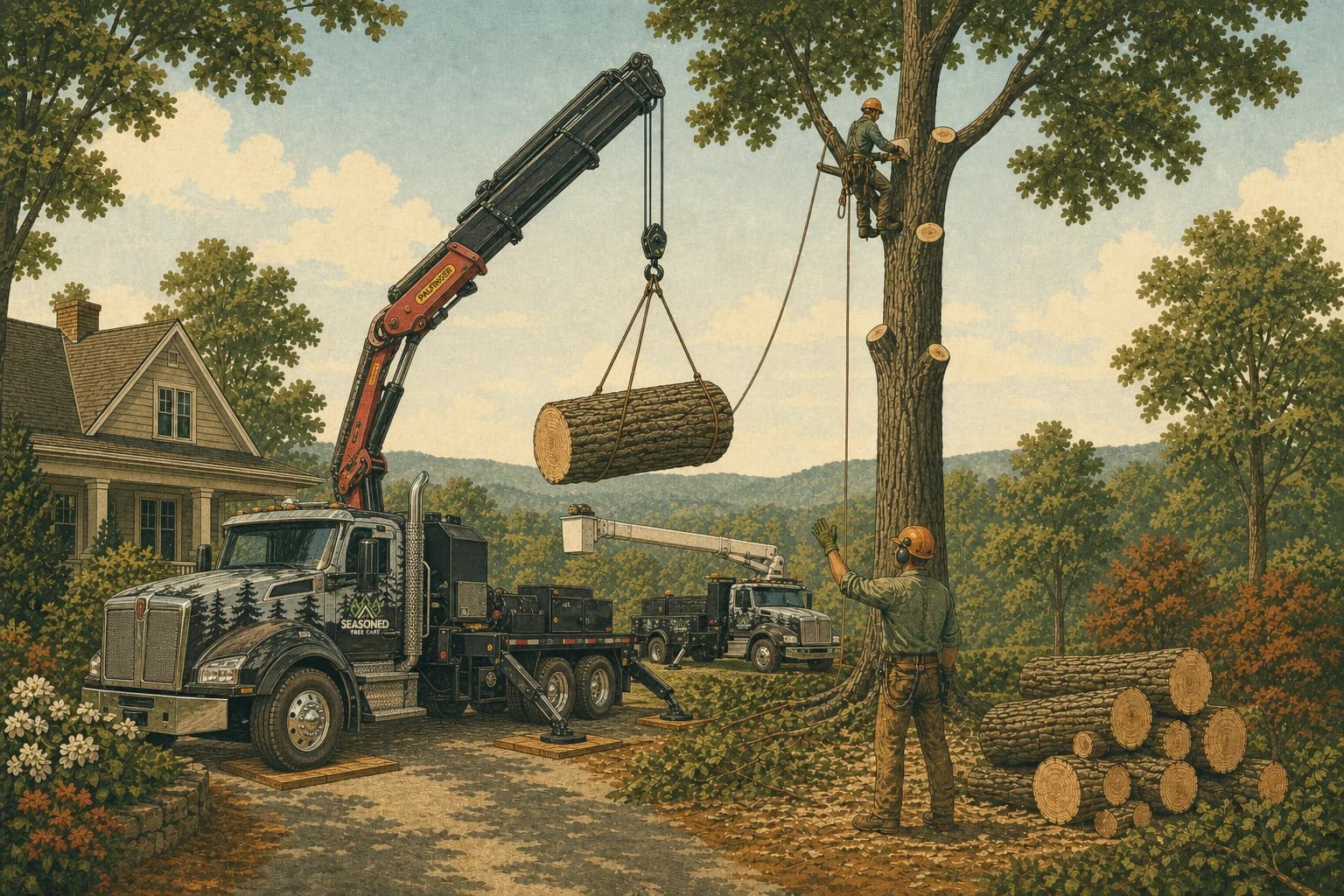
Crane tree removal uses a crane to support and move sections of a tree to a planned landing area while a coordinated crew dismantles it. It can be useful around houses, limited landing space and some compromised trees, provided the equipment and site are suitable. This guide explains the homeowner decisions behind the work, shows our Greenville field footage and uses a paid Anderson invoice to put the price in context.
Section 01Watch our crew on a Greenville crane job
From our crew · Greenville, SC
Crane Tree Removal — Greenville, SC
A field visit with our crew and crane at a Greenville tree-removal site. Watch the equipment and the space around the work, then use the access checklist below to prepare for your own estimate. The clip illustrates our work; its setup cannot establish whether a crane will fit at your property.
This field video is a separate example from the invoice and job summaries in this guide.
Section 02When a crane earns its place in the plan
Tree over a roof or enclosed yard
- Why consider a crane?
- Sections may be lifted to a separate processing area.
- What can change the decision?
- Usable reach, capacity, the load route and a suitable landing area.
Large or compromised tree
- Why consider a crane?
- The crew evaluates alternatives to relying on the tree for conventional rigging.
- What can change the decision?
- Condition, attachment options and the complete work plan; a crane does not make every tree manageable.
Several removals in one area
- Why consider a crane?
- One suitable setup may reduce repeated material handling.
- What can change the decision?
- The position of each tree and whether moving the crane changes the estimate.
Soft soil, septic system or confined driveway
- Why consider a crane?
- A different setup location might be considered.
- What can change the decision?
- Ground support and equipment loads can rule out the location even when the truck fits.
| Situation | Why consider a crane? | What can change the decision? |
|---|---|---|
| Tree over a roof or enclosed yard | Sections may be lifted to a separate processing area. | Usable reach, capacity, the load route and a suitable landing area. |
| Large or compromised tree | The crew evaluates alternatives to relying on the tree for conventional rigging. | Condition, attachment options and the complete work plan; a crane does not make every tree manageable. |
| Several removals in one area | One suitable setup may reduce repeated material handling. | The position of each tree and whether moving the crane changes the estimate. |
| Soft soil, septic system or confined driveway | A different setup location might be considered. | Ground support and equipment loads can rule out the location even when the truck fits. |
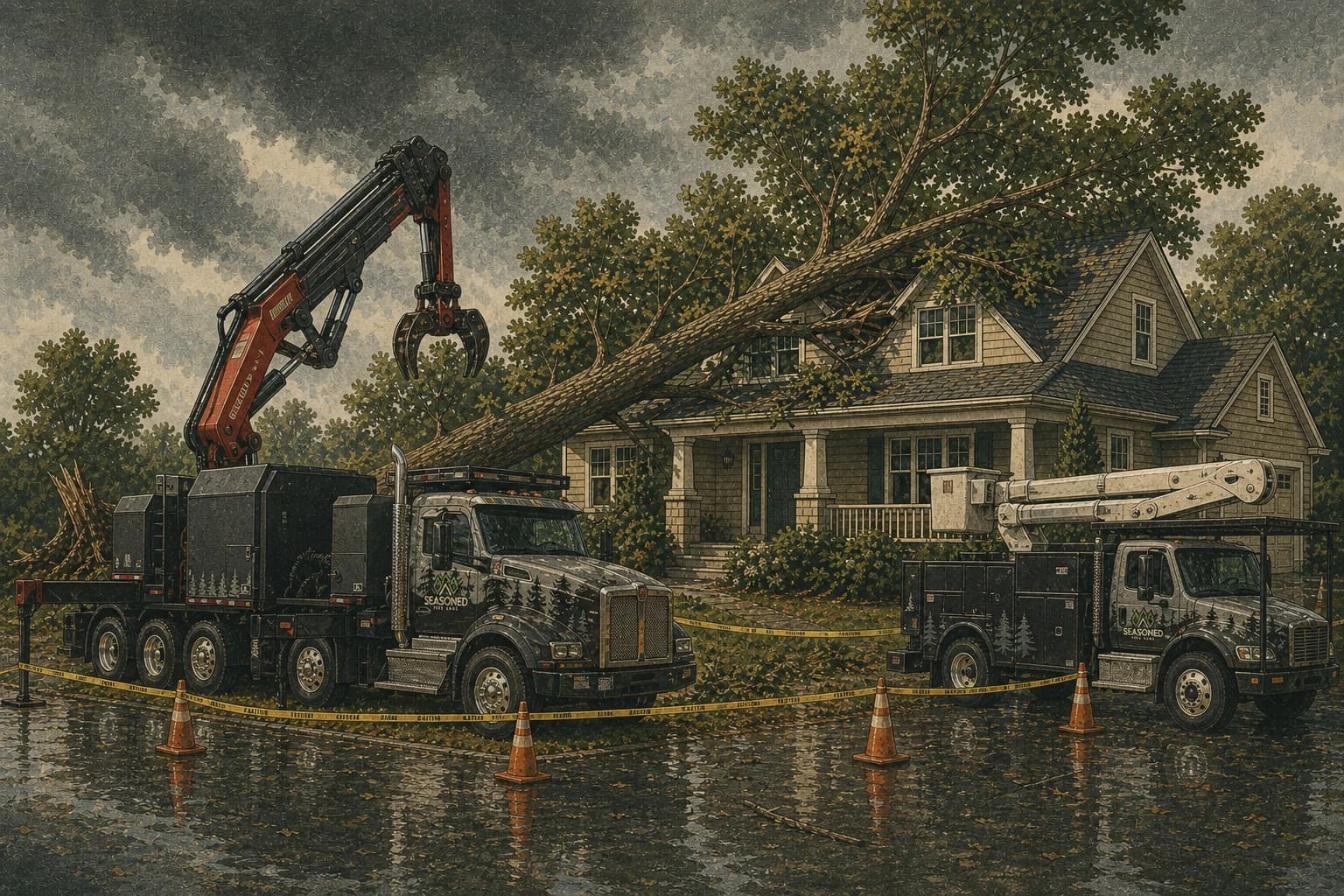
Climbing and rigging, a lift, crane assistance or a combination may be appropriate. Ask the estimator to explain the recommendation for your property. Our tree removal over a house guide focuses on planning around a standing tree above a roof. If a tree has already fallen onto a structure, start with what to do when a tree falls on a house.
Section 03The full process, step by step
- Assess the site and tree. Review condition, structures, utilities, access, ground conditions and the landing area before selecting equipment.
- Agree on the written scope. Identify trees, retained landscaping, access arrangements, debris removal and stump finish.
- Plan equipment placement. The operator evaluates the actual crane configuration and loads, the setup surface, outriggers and working clearances.
- Establish the work area. Coordinate the operator and tree crew, restrict access and keep people away from suspended loads and the processing area.
- Remove sections under the crew’s lift plan. The qualified crew manages attachment, cutting, movement and landing; the sequence depends on the tree and the site.
- Process material and complete the agreed finish. Load or retain wood, handle brush and address stump work as separately specified. Walk through the completed scope together.
Section 04Can a crane reach a tree in my backyard?
Possibly. The truck may set up in a driveway or another suitable location rather than driving through the backyard gate. The important measurement is the working reach from the proposed setup to the load, together with the crane’s capacity in that configuration. A reach figure advertised for a crane is not a promise that it can lift every tree section at that distance.
- Show the full route: street approach, drive, turn, setup and loading area. A photo of the trunk alone misses most access questions.
- Point out septic tanks and drainfields, wells, irrigation, private buried lines, retaining walls, filled ground and recently disturbed soil.
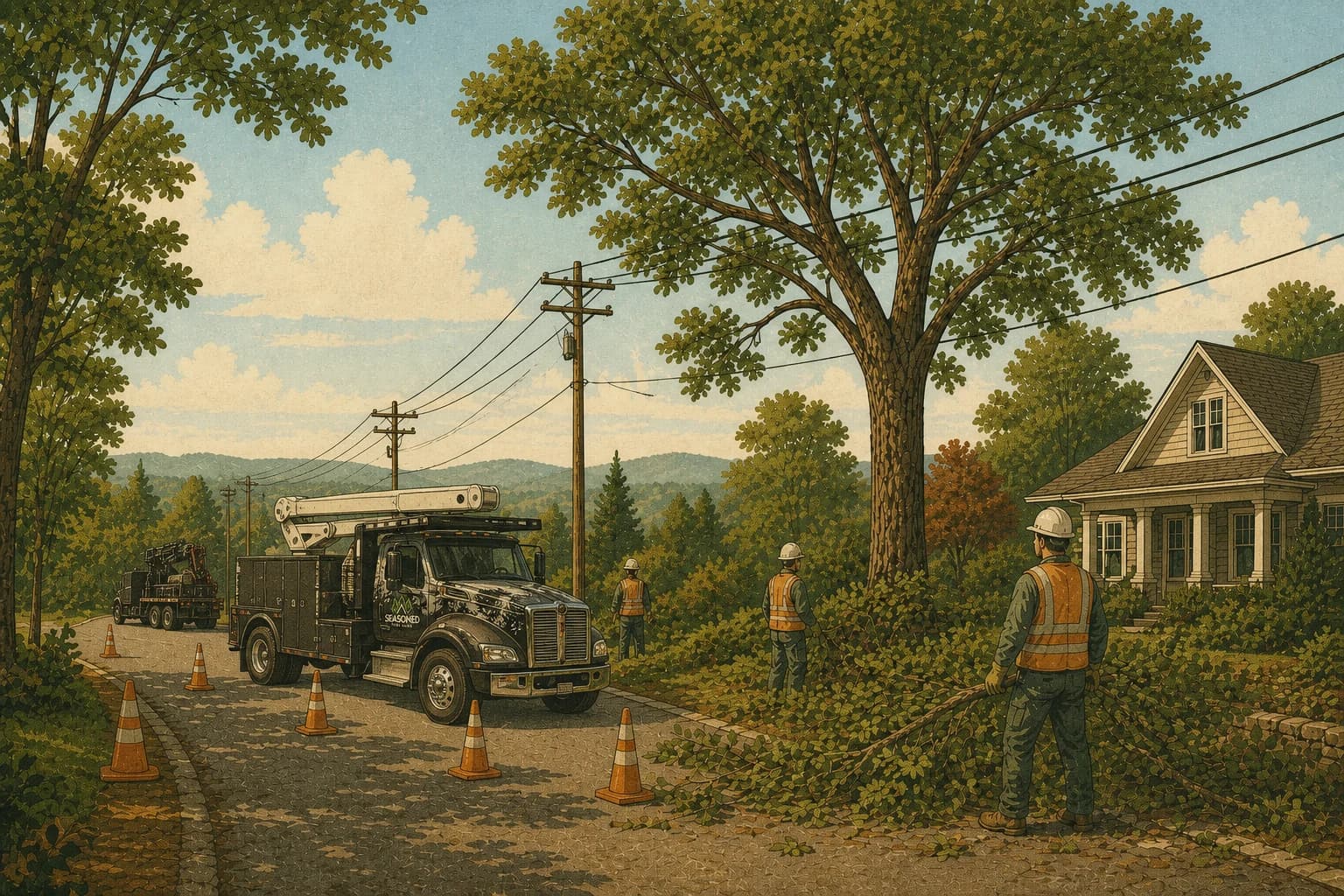
- Identify overhead lines, roof edges, neighboring trees and anything that restricts the boom or load path. Utility coordination may be necessary.
- Confirm gates, parked vehicles, occupied spaces, pets and shared access. Do not remove a fence or arrange a street closure until the work plan requires it.
- Discuss mats and surface protection where appropriate. Ground protection does not create a guarantee against marking or damage. Wet conditions can require rescheduling or a different method.
You can send photos from a safe location before the visit, including the entire tree, surrounding structures and the driveway. Useful photos help us prepare; they do not replace measuring and assessing the setup. Our crew can explain which access details affect your crane removal estimate.
Section 05What does crane tree removal cost?
There is no reliable flat price based only on height or crane ownership. The written estimate combines the tree work with the equipment, crew, setup, processing and finish that the site needs. Crane assistance can reduce some handling on a suitable job, but it also requires equipment and planning. Compare the complete proposed scope rather than assuming a crane must be cheaper or more expensive.
Leaning water oak removal; trunk cavity noted; crane assistance, debris removal and low stump specified
- Recorded invoice amount
- $2,500
Separate retained water oak pruned for clearance
- Recorded invoice amount
- $500
Paid invoice total for both lines
- Recorded invoice amount
- $3,000
| Completed Anderson job · December 2025 | Recorded invoice amount |
|---|---|
| Leaning water oak removal; trunk cavity noted; crane assistance, debris removal and low stump specified | $2,500 |
| Separate retained water oak pruned for clearance | $500 |
| Paid invoice total for both lines | $3,000 |
These selected examples come from Seasoned Tree Care jobs marked closed, with a recorded completion date and a paid invoice. We checked that each invoice belonged to the job shown. Amounts below are the recorded invoice line items in US dollars, not a citywide survey or a current quote. Completion is shown by month; customer names, street addresses and account identifiers are omitted. Bundled services stay bundled because the records do not support inventing a separate price.
Past work, summarized from completed jobs with paid invoices. Customer names and street addresses are omitted. Descriptions reflect the recorded scope; they are not independent condition reports.
Completed December 2025
Leaning water oak removal near a house
A large leaning water oak with a trunk cavity was listed for removal at this Anderson home. Crane assistance, debris removal and a low stump were part of the removal plan. A different water oak was retained and pruned for house clearance and low-growing branches.
A removal plan and a pruning plan can serve different trees on the same property. Ask which tree can be retained and what stump finish is included.
See the local project report →This removal line was $2,500, so the whole-job $3,000 total should not be described as the removal price. The record also does not justify a claim about hours saved, exact tree height or an equipment model. For more scope comparisons, see Greenville removal costs and Anderson removal costs.
Section 06Crane types and what the equipment name does not tell you
A knuckle-boom crane has an articulated boom; a conventional telescopic crane extends its boom in a different configuration. Attachments, operating configuration and crew method also matter. Seasoned Tree Care uses crane equipment in its tree work, as shown in the field footage. The useful question for a homeowner is how the proposed setup will reach and handle this tree while accounting for the property.
Do not compare contractors by a crane brand, advertised reach or machine size alone. Ask who operates it, how access is assessed and whether the estimate includes the tree crew, debris trucks and cleanup. Verify insurance documentation for the company doing the work using our tree-service hiring checklist.
Section 07What happens to the stump and yard?
Lifting out the tree does not extract its underground root system. A removal may leave a low stump; grinding may be a separate line. If the area will become a planting bed, lawn or building footprint, specify that before the estimate so the finish can be planned. Read stump grinding versus removal before choosing the preparation.
Section 08Questions to ask before a crane removal
- Where is the proposed setup, and what could make it unsuitable on the work date?
- How will the tree sections reach the landing area, and what spaces need to be kept clear?
- What access or utility arrangements must be resolved first?
- Does the quote include all tree work, hauling, stump work and the finish I expect?
- If weather, access or tree condition changes the plan, how will the revised scope and cost be approved?
Let us assess the tree, crane access and cleanup together.
Get a written estimate →Quick answers
Frequently asked questions
It can be an appropriate removal method when the site and tree suit it. Safety depends on a qualified crew, equipment condition, ground support, lift planning and keeping people out of the work area. A crane does not eliminate tree-work risk or guarantee a damage-free result.
A selected December 2025 Anderson invoice listed $2,500 for a crane-assisted water oak removal and $500 for separate pruning, for a $3,000 total. That is one historical example. The tree, crane setup, reach, cleanup and access determine a new quote.
Not necessarily. A driveway or another suitable setup point may provide access if reach, capacity, ground support and the load path work. Only an on-site assessment can establish whether a particular setup is suitable.
The schedule depends on setup, the number and condition of trees, the removal method and material handling. Ask for the expected work window for the entire job, including cleanup. A short lifting clip is not evidence of a whole-job duration.
Only if it is in the written scope. Cutting the remaining stem low, grinding a stump, hauling grindings and extracting roots are different tasks. Specify the finish needed for the area.
Related services & areas
Sources & further reading
Published by Seasoned Tree Care LLC. Serving Anderson, Greenville & communities across Upstate South Carolina. This article is general information, not a substitute for an on-site assessment.