Start here
Drive through almost any subdivision in Simpsonville, Mauldin, Powdersville, or the rest of Greenville's suburban ring and you'll see them: rows of tall, straight pines towering over the rooftops. They're loblolly pines, and they're the tree we get called about most after a storm. If you live under them, it's worth understanding why they fail so often here — and what you can actually do about it before one ends up on your roof.
Section 01Why your subdivision is full of pines
Loblolly is the most widely planted timber tree in the South, and a lot of the Upstate's suburban expansion happened on land that used to be pine plantation or pine woodland. As that acreage was developed, builders frequently left stands of mature loblollies standing — they give a new neighborhood instant height, shade, and screening. The South Carolina Forestry Commission documents just how dominant loblolly is across the state's forests. The catch is that those trees grew up packed tightly together in a stand, sheltering one another from the wind.
Section 02Why loblollies fail more than other trees here
Tall, top-heavy, and shallow-rooted
A mature loblolly puts a lot of height and crown weight on a relatively slender trunk and a comparatively shallow root system. That combination is fine in a dense stand and risky in the open. In the saturated red clay common around Greenville, those roots have less to hold onto when the soil is soaked — which is exactly when the storms arrive.
Suddenly exposed to wind
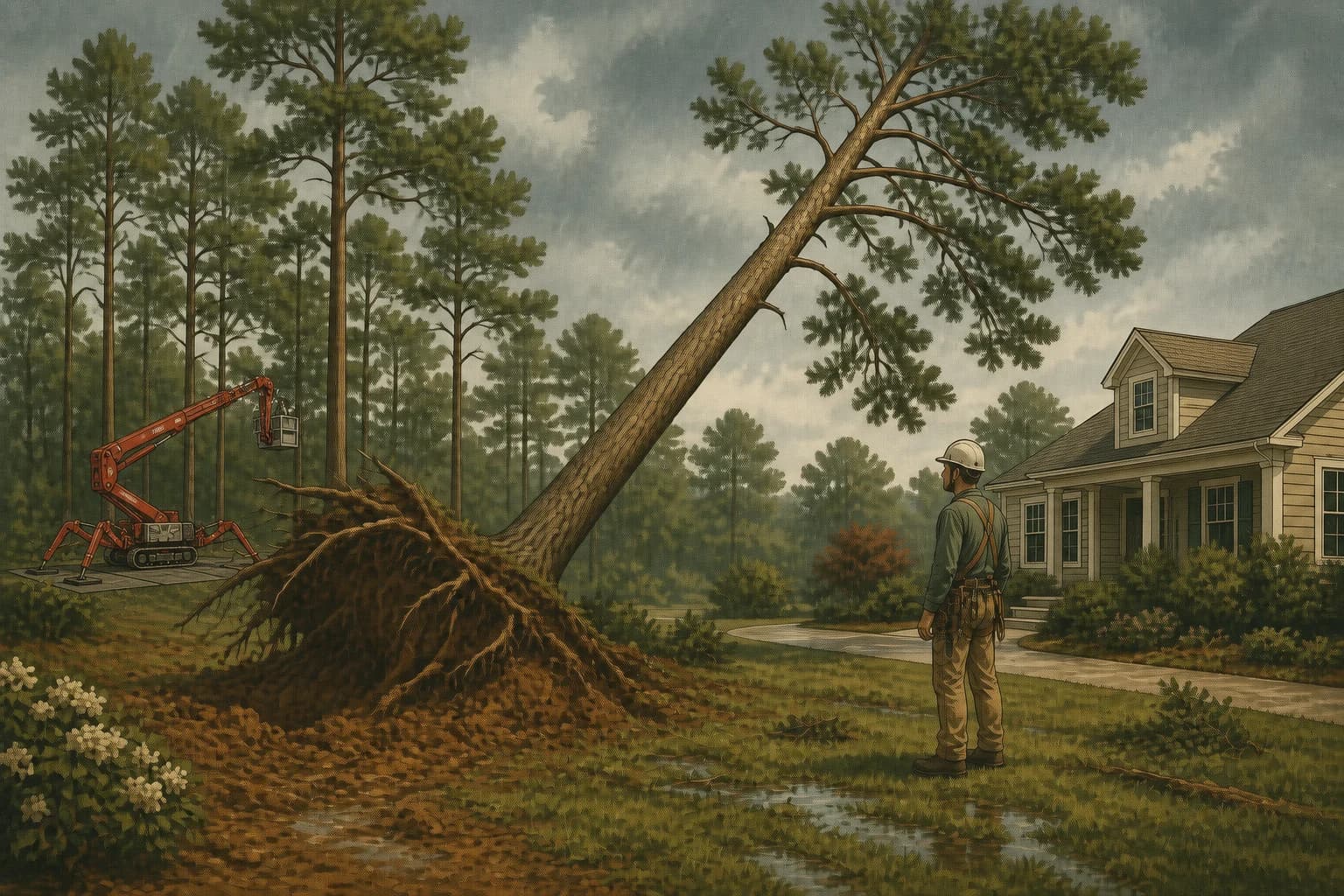
Here's the part homeowners rarely hear: a stand-grown pine that suddenly loses its neighbors — to development, lot clearing, or a previous removal — is now catching far more wind than it ever grew to withstand. It didn't develop the taper and root strength of an open-grown tree, and it can't adapt fast enough. That newly exposed pine standing alone behind your house is often more vulnerable than it looks.
Storms, ice, and saturated soil
Upstate thunderstorms bring straight-line winds and downpours; the occasional ice storm loads crowns with weight they aren't built for. Pile any of that on top of clay soil that's already waterlogged and you have the recipe for the leaning, snapped, and uprooted pines we clear every storm season.
Section 03Warning signs to watch for
Pines often give clues before they fail. The International Society of Arboriculture's guidance on tree risk is worth reading, but the signs most relevant to suburban loblollies are:
- A new lean, or a lean that's getting worse.
- Soil heaving, mounding, or cracking on one side of the base — a sign the root plate is moving.
- Freshly exposed or lifted roots.
- Thinning, yellowing, or browning needles when the rest of the tree should be green.
- Large dead limbs, or a dead top.
- Pitch (sap) oozing on the trunk, small holes, or sawdust — possible borers or beetles.
- A pine that recently lost its neighboring trees and now stands alone over a structure.
Section 04What you can actually do
You can't prune a tall loblolly into being wind-firm, and topping it is worse than useless — it creates weak regrowth and a more dangerous tree. Clemson Extension and the ISA both advise against topping. What does help is honest assessment and the right action for each tree:
- Have a professional evaluate the pines closest to your home and driveway, especially any that are newly exposed or leaning.
- Remove deadwood and clearly hazardous limbs on otherwise sound trees.
- Remove pines that lean toward a structure, show root-plate movement, or are in decline — before a storm does it the hard way.
- When clearing a lot, think about which pines will be left standing alone and whether they can handle the new exposure.
- Keep an eye on the trees over time; risk changes after every big storm and every nearby removal.
On suburban lots, taking a big pine down is rarely as simple as felling it — there's a house, a fence, and the neighbor's roof close by. That's where sectional rigging or a crane lift comes in, so the tree comes out in controlled pieces rather than dropped into a space that isn't there.
Worried about a pine leaning toward your house in Simpsonville, Mauldin, Powdersville, or anywhere around Greenville? We'll assess it honestly and tell you whether it needs to come out.
Request a free pine assessment →The pines that shade your neighborhood aren't all problems — but the leaning, exposed, and declining ones over your roof deserve attention before storm season, not after. If you're not sure which is which, that's exactly what a professional assessment is for. Call (864) 762-1253 and we'll take a look.
Quick answers
Frequently asked questions
Much of the Upstate's suburban growth happened on land that was previously pine plantation or pine-dominated woodland. Loblolly pine is the South's most-planted timber species, so when those tracts were developed, builders often left stands of mature loblollies in place for instant shade and privacy. The result is neighborhoods full of tall, even-aged pines that grew up crowded together and are now exposed.
In Upstate storms, pines are over-represented in failures for a few reasons: they grow tall and slender with the weight up top, they're relatively shallow-rooted, and stand-grown pines that lose their neighbors to development suddenly catch much more wind than they evolved to handle. Saturated clay soil and ice loading make it worse. Healthy hardwoods are generally more wind-firm, though no tree is immune.
Watch for a new or worsening lean, soil heaving or cracking on one side of the base, fresh root exposure, thinning or browning needles, large dead limbs, holes or sawdust suggesting borers, and oozing pitch on the trunk. A pine that has lost nearby trees and now stands alone is also at higher risk. Any of these is worth a professional look — sudden lean or heaving soil should be treated as urgent.
It depends on the tree and the situation. A sound pine can sometimes be made safer by removing deadwood and reducing risk, but you can't meaningfully 'wind-proof' a tall, shallow-rooted loblolly with pruning, and topping it only makes it more hazardous. When a pine is leaning toward the house, declining, or freshly exposed and over a structure, removal is often the honest answer. We'll tell you which trees are genuinely a concern and which are fine.
Related services & areas
Sources & further reading
- South Carolina Forestry Commission — Loblolly pine and South Carolina's forests and timber species
- Clemson Cooperative Extension Home & Garden Information Center — Tree health, pests, and care of pines in South Carolina landscapes
- International Society of Arboriculture / Trees Are Good — Tree risk assessment and recognizing hazardous trees
Published by Seasoned Tree Care LLC. Serving Anderson, Greenville & communities across Upstate South Carolina. This article is general information, not a substitute for an on-site assessment.