
Start here
Hiring a tree service is unlike hiring most other home contractors. The work happens high in the air, with heavy loads and powerful equipment, often within a few feet of your roof, your power line, or your neighbor's fence. That means choosing a company is mostly an exercise in reducing risk before a single saw starts. This guide walks through exactly what to verify, what to read in the paperwork, the red flags that should end a conversation, and the questions to ask — plus a printable checklist you can take into your estimate.
Section 01Insurance: the single most important thing to verify
OSHA classifies tree care as high-hazard work, and for good reason — it routinely involves heights, chainsaws, chippers, and heavy suspended loads. That hazard is precisely why insurance is not a formality. If an uninsured crew damages your home or a worker is hurt on your property, you can be left exposed. Verifying coverage is the first and most important filter when choosing a tree service.
General liability insurance
General liability insurance covers damage the company causes to your property — a limb through a roof, a section that catches a fence, a dropped log on a driveway. Ask for the coverage amount, not just a yes-or-no answer. Seasoned Tree Care carries $2 million in general liability coverage, which is sized for the large removals and crane work the company performs.
Workers' compensation
Workers' compensation covers the crew if someone is injured on the job. This protects you, the homeowner, because without it an injured worker may have grounds to pursue a claim against the property owner. A company that runs a real crew at height should carry workers' comp; Seasoned Tree Care does.
Certificate of insurance (COI)
A certificate of insurance is the document that proves coverage is active. Ask for it, and ideally ask that it be sent directly from the insurer or agent rather than handed to you by the crew. Check that the policy dates are current and the amounts match what you were quoted. Seasoned Tree Care provides a certificate of insurance on request — a request any reputable company should welcome rather than resist.
Section 02The paperwork: scope, cleanup, and terms
Written scope of work
Everything you agree to should be in writing. A clear written scope of work spells out which trees, which work (removal, trimming, stump grinding), what stays and what is hauled away, and the total price. A verbal handshake leaves room for disputes about what was actually included. Seasoned Tree Care provides free written estimates so you have the details in hand before committing.
Cleanup terms
Cleanup is one of the most common sources of disappointment, because expectations differ. Does the price include hauling all wood and brush away, or are chips and logs left on site? Will the lawn be raked and the driveway cleared? Will ruts be addressed? Get the cleanup standard written into the scope so 'done' means the same thing to both of you.
Deposits and payment terms
Get payment terms in writing alongside the scope. Be cautious about large up-front deposits, particularly in cash, as a demand for full payment before any work begins is a classic warning sign. Many established companies can begin residential work with little or no deposit and bill on completion. Confirm what is due, when, and how before you agree.
Change orders
Sometimes a job changes once work starts — hidden decay is found, or you decide to add a second tree. A trustworthy company handles this with a change order: a written, agreed adjustment to scope and price before the extra work proceeds, not a surprise added to the final bill. Ask how change orders are handled so there are no surprises.
Section 03Equipment and the crane question
Equipment suitability
The right equipment for your tree makes the job safer and more efficient. A large removal over a house is a different proposition than a small open-yard tree, and the gear should match. When you get your estimate, ask how the company plans to take the tree down and what equipment they will bring — a clear, specific answer is a good sign. Ask who operates the equipment and performs the tree work, whether equipment is owned or rented. Ownership alone does not establish competence or insurance coverage.
Crane ownership vs subcontracting
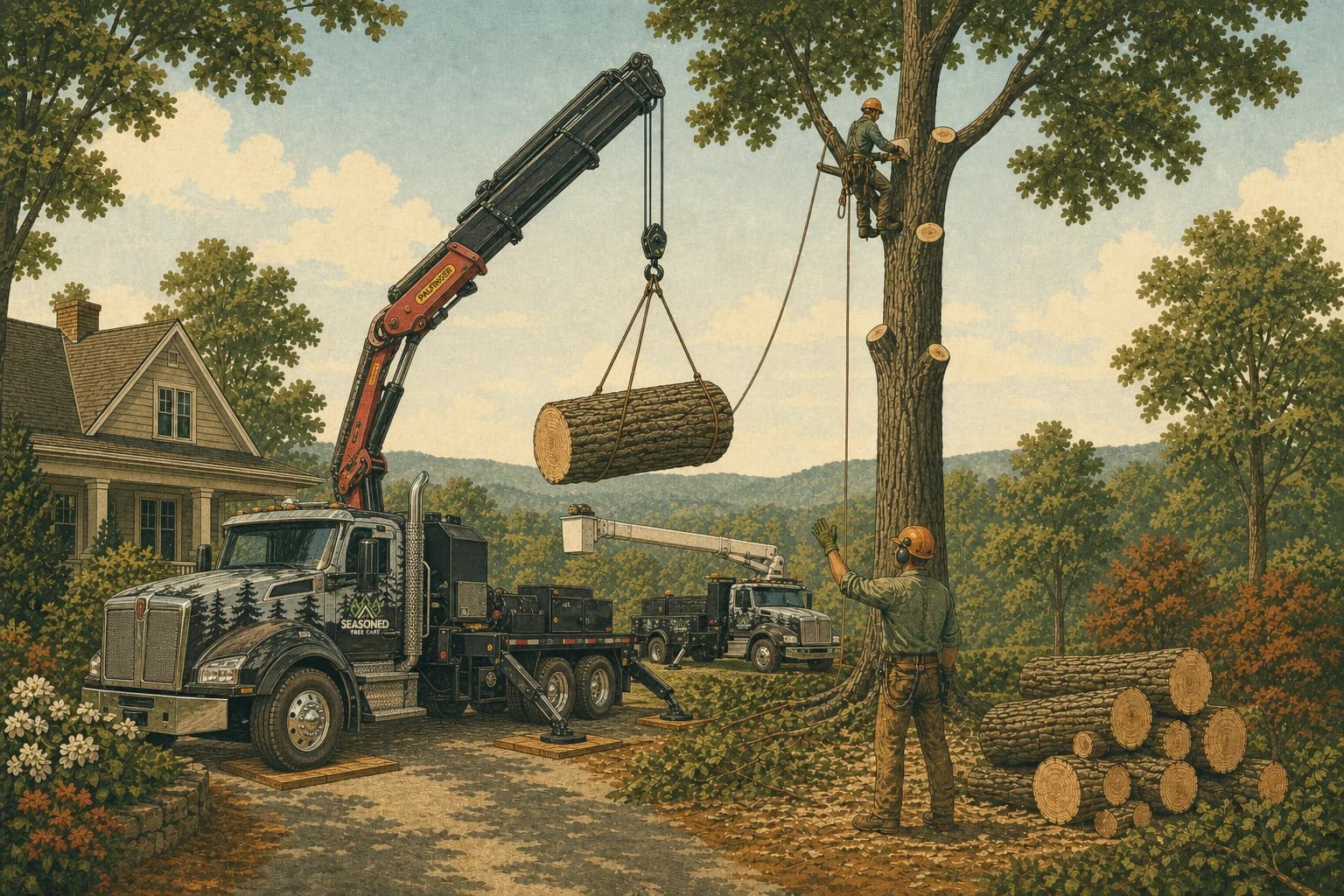
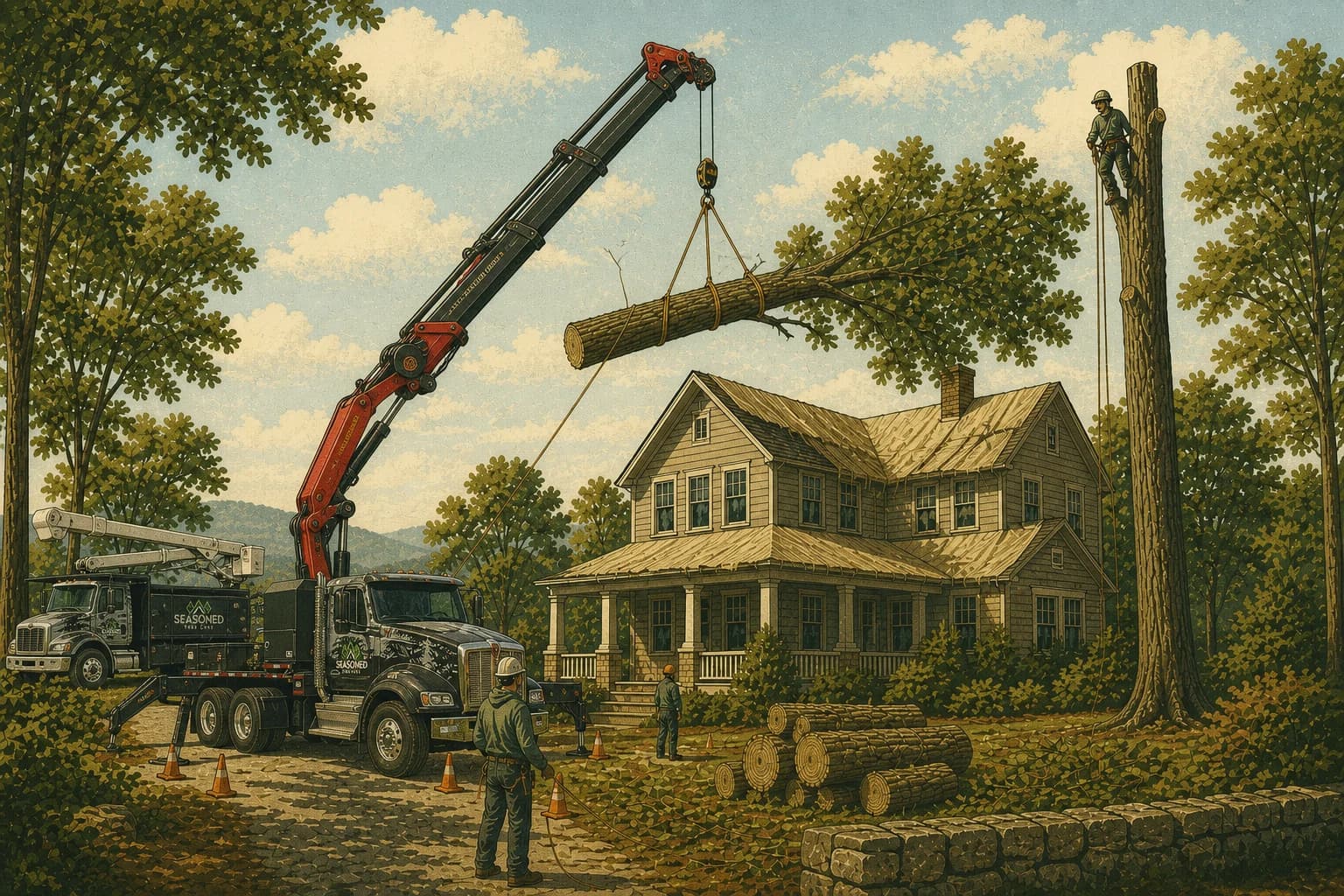
Some companies subcontract their crane work, which can mean waiting on a third party's schedule, a markup on the crane, and split accountability if something goes wrong. Seasoned Tree Care owns its crane (a Palfinger) and its chippers rather than subcontracting. Owning the equipment means tighter scheduling, operators familiar with their own machine, and a single company responsible for the whole job. You can read more about how this works on our crane tree removal page, or learn about the company on our about page.
Utility-line restrictions
Trees touching or near power lines are a special case. Line-clearance work near energized conductors is hazardous and, in many situations, must be coordinated with the utility — homeowners and general tree crews should not be working directly on lines that the utility controls. If a tree is contacting a power line, call your electric utility about line clearance before scheduling removal. A responsible company will tell you when the utility needs to be involved rather than improvising near live wires.
Section 04Reputation: references and reviews
References
It is reasonable to ask a company about recent local work and whether they can point you to references. Talking to a past customer can tell you about timeliness, cleanup, and how the crew treated the property — details that do not show up in a price.
Reviews
Online reviews are useful context when read with judgment. Look for specifics — how a company handled a difficult removal, cleanup, or a problem — rather than star counts alone. A pattern of detailed, consistent feedback is more meaningful than a single glowing or angry post.
Credentials and professional standards
The International Society of Arboriculture, through its Trees Are Good resources, encourages homeowners to hire qualified tree care providers and to ask about training and professional standards. Clemson Cooperative Extension's HGIC offers similar guidance for South Carolina homeowners on selecting and working with tree professionals. Ask how a crew is trained and how they approach safety — knowledgeable answers signal a company that takes the work seriously.
Section 05Permits and HOA requirements
Before removal, find out whether you need permission. Some municipalities regulate the removal of certain trees, and rules differ between the City of Anderson, the City of Greenville, and unincorporated county areas. Separately, many homeowners' associations have their own tree rules. Check with your local government and your HOA. A good tree service will raise the topic, but the property owner is ultimately responsible for compliance, so confirm before the crew arrives.
Section 06Red flags
Any one of these is a reason to slow down; several together is a reason to walk away.
- Cannot or will not provide a certificate of insurance from their insurer or agent.
- No workers' compensation, or vague answers about coverage and crew safety.
- Demands full payment, or a large cash deposit, before any work begins.
- Only a verbal quote — no written scope, no clear cleanup terms, no firm price.
- High-pressure tactics, 'today only' discounts, or door-to-door solicitation after a storm.
- No physical address, no consistent business name, or a price that is far below every other bid.
- Plans to work directly on or against power lines without involving the utility.
- Reluctant to let you contact references or confirm policy details.
Section 07Questions to ask before you hire
Bring these to your estimate. Comparing answers across companies tells you as much as comparing prices.
- Do you carry general liability insurance and workers' compensation, and what are the coverage amounts?
- Can you provide a certificate of insurance directly from your agent?
- Will I get a written scope of work with the total price before work starts?
- What does cleanup include — full haul-away, chips left, logs kept — and is the lawn restored?
- What are your payment terms, and is any deposit required?
- How are change orders handled if the job grows once work begins?
- Do you own your equipment, including any crane, or do you subcontract it?
- How will you handle any trees near power lines, and will the utility be involved?
- Are there permit or HOA requirements I should know about for my address?
Getting an estimate is the easiest way to see this checklist in action — ask us your toughest questions and request our certificate of insurance.
Request a free written estimate →Section 08Printable hiring checklist
Use the page's Print button to take this list with you when you meet a tree service. Check each box before you sign anything.
- Confirmed current general liability insurance and coverage amount.
- Confirmed workers' compensation coverage.
- Received a certificate of insurance, ideally direct from the insurer or agent.
- Got a written scope of work listing each tree and task.
- Cleanup standard is spelled out in writing (haul-away, chips, logs, lawn).
- Payment terms are in writing, with no oversized up-front cash deposit.
- Asked how change orders are handled.
- Asked what equipment will be used and whether the crane (if any) is owned or subcontracted.
- Discussed any power-line conflicts and whether the utility must be called.
- Checked permit rules with the local government for my address.
- Checked my HOA's tree requirements, if applicable.
- Asked for references and read recent reviews for specifics.
Section 09Putting it together
Choosing a tree service comes down to verifying coverage, reading the paperwork, matching equipment to the job, and watching for the warning signs above. A company that answers these questions plainly and puts the details in writing is one you can hold accountable. Seasoned Tree Care serves Anderson, Greenville, and the wider Upstate from Honea Path, SC, with the insurance, owned equipment, and written estimates that this checklist is built to find. See how that looks in practice on our tree service in Greenville, SC page, explore tree removal, learn about our crane work, or call (864) 762-1253 — 24/7 for emergencies.
Section 10What a useful written tree-work scope looks like
Past work, summarized from completed jobs with paid invoices. Customer names and street addresses are omitted. Descriptions reflect the recorded scope; they are not independent condition reports.
Completed November 2025
Driveway oak removal and pruning a retained oak
At this Clemson property, the job paired removal of the oak closest to the driveway with grinding its stump. A separate oak was retained for pruning to address deadwood and clearance from the house.
Two nearby trees may need different treatments. A written estimate should identify the tree to remove and the one to retain and prune.
See the local project report →Use our Greenville removal-cost examples, Anderson removal-cost examples and cleanup checklist to compare equivalent scopes. A low bid is difficult to interpret when it omits hauling or the stump finish you need.
Tree identification and purpose
- Why it belongs in the estimate
- The crew and owner should agree which tree is removed and which is retained.
Pruning limits or removal finish
- Why it belongs in the estimate
- Clearance pruning, a low stump and stump grinding are different tasks.
Equipment and access
- Why it belongs in the estimate
- Who performs the work, which access is needed and any arrangements before arrival.
Material handling
- Why it belongs in the estimate
- Wood, brush, chips and surface restoration should have a stated destination or finish.
Price and changes
- Why it belongs in the estimate
- Separate service lines where possible, the total and how extra work requires agreement.
| Ask for this detail | Why it belongs in the estimate |
|---|---|
| Tree identification and purpose | The crew and owner should agree which tree is removed and which is retained. |
| Pruning limits or removal finish | Clearance pruning, a low stump and stump grinding are different tasks. |
| Equipment and access | Who performs the work, which access is needed and any arrangements before arrival. |
| Material handling | Wood, brush, chips and surface restoration should have a stated destination or finish. |
| Price and changes | Separate service lines where possible, the total and how extra work requires agreement. |
Use our Greenville removal-cost examples, Anderson removal-cost examples and cleanup checklist to compare equivalent scopes. A low bid is difficult to interpret when it omits hauling or the stump finish you need.
Seasoned Tree Care is fully insured, owns its equipment, and provides written estimates — ask us for our certificate of insurance.
Quick answers
Frequently asked questions
At minimum, look for general liability insurance and workers' compensation, and ask for a certificate of insurance (COI) sent directly from the insurer or agent. Liability protects your property if something is damaged; workers' comp protects you from claims if a worker is injured on your land. Seasoned Tree Care carries $2 million in liability coverage plus workers' comp and provides a certificate of insurance on request.
Ask that the certificate be sent directly from the insurance agency rather than handed to you by the crew, and confirm the policy dates are current and the coverage amounts match what you were told. You can call the agent listed on the certificate to confirm the policy is active. A reputable company expects this request and is glad to accommodate it.
Be cautious about large up-front deposits, especially in cash. Many established companies can start residential work with little or no deposit and bill on completion, or take a modest deposit for materials or scheduling. Always get payment terms in writing as part of the scope of work, and avoid anyone who pressures you to pay the full amount before work begins.
It depends on where you live. Some municipalities and many homeowners' associations regulate the removal of certain trees, and rules differ between the City of Anderson, the City of Greenville, and unincorporated county areas. Check with your local government and your HOA before removal. A good tree service will discuss permits and HOA requirements with you, but the property owner is ultimately responsible for compliance.
A company that owns its crane and chippers controls its own schedule, equipment condition, and operator familiarity, rather than waiting on and marking up a subcontractor. Seasoned Tree Care owns its Palfinger crane and its chippers rather than subcontracting, which helps with scheduling, safety on tight removals, and a single point of accountability for the work.
Related services & areas
Sources & further reading
- ISA / Trees Are Good — Hiring a qualified tree care provider and the value of professional credentials
- OSHA — Tree care operations are high-hazard work governed by recognized safety standards
- Clemson Cooperative Extension HGIC — Guidance on selecting and working with tree care professionals in South Carolina
Published by Seasoned Tree Care LLC. Serving Anderson, Greenville & communities across Upstate South Carolina. This article is general information, not a substitute for an on-site assessment.