Start here
Of all the trees we're asked to remove, the ones growing over a house are in a category of their own. A tree in an open field can be felled in one direction and the worst case is a dent in the turf. A large tree leaning over a roof has no such margin — there is simply nowhere for a heavy piece to go that isn't a roof, a gutter, a window, or a person. That single fact changes everything about how the job has to be planned and which tools belong on it. This guide explains why an over-house tree is so uniquely dangerous, how a crane changes the equation, how to tell a tree that needs to come out from one worth watching, and what a careful removal actually involves.
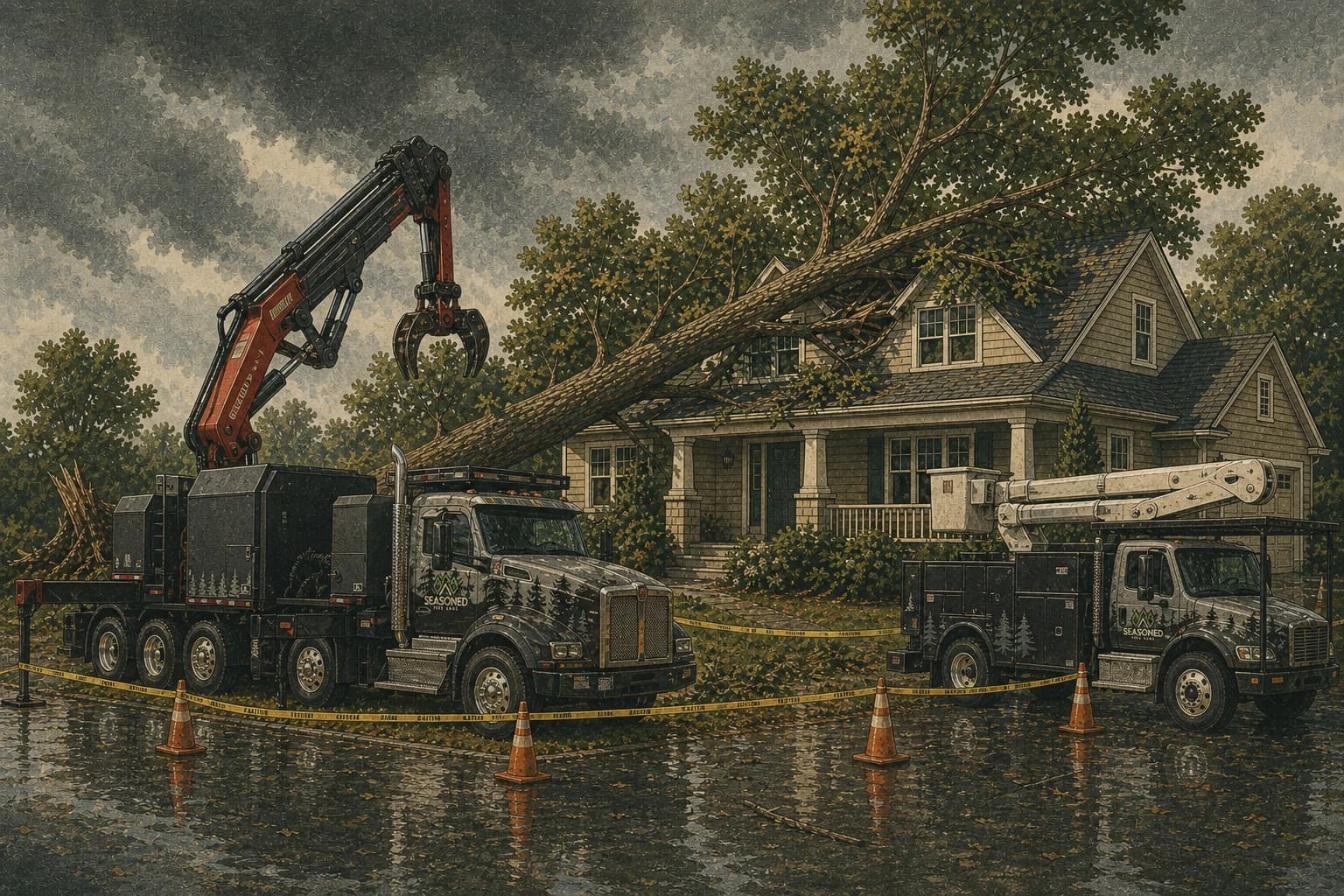
This guide concerns a standing tree over a roof. For the equipment process, a real invoice breakdown and backyard access questions, see crane tree removal explained. If the tree has already fallen onto the structure, use what to do after a tree falls on a house.
Section 01Why a tree over a house is uniquely dangerous
The core problem is the missing drop zone. In a normal removal, a crew can lower cut pieces into a clear area, or fell the trunk into open space. Over a house, that open space doesn't exist. Every cut has to be controlled the entire way down, because a piece that drops, swings, or rolls the wrong way lands on something expensive — or someone.
Several factors stack on top of that:
- No safe fall direction — the structure occupies the space a tree would normally be lowered into, so nothing can be allowed to free-fall.
- Tight clearances to structures and utilities — roofs, chimneys, gutters, fences, pools, and service drops crowd the work area and shrink the margin for error.
- Decay and dead wood — a tree that has been declining is weaker and less predictable exactly where it overhangs the house, and hidden rot at a limb union can let a section fail without warning.
- Lean and load — a tree leaning toward the structure is already storing energy, and cutting in the wrong order can release that load toward the house instead of away from it.
- Climber exposure — dismantling a big, compromised tree by hand means a climber spends hours working inside the very structure that's failing.
ISA's Trees Are Good resources stress that leaning trees, dead limbs over targets, and decay at the base or branch unions are classic warning signs that warrant a professional look — and an over-house tree puts a structure directly in the line of every one of those failures.
Section 02How a crane changes the job
The traditional way to take down a tree over a roof is to climb it and rope pieces down one at a time, lowering each cut limb over or past the house to a ground crew. A skilled crew does this well every day, but it means heavy sections travel through the air above the structure, and the rigging — not the roof — is all that stands between a section and the shingles.
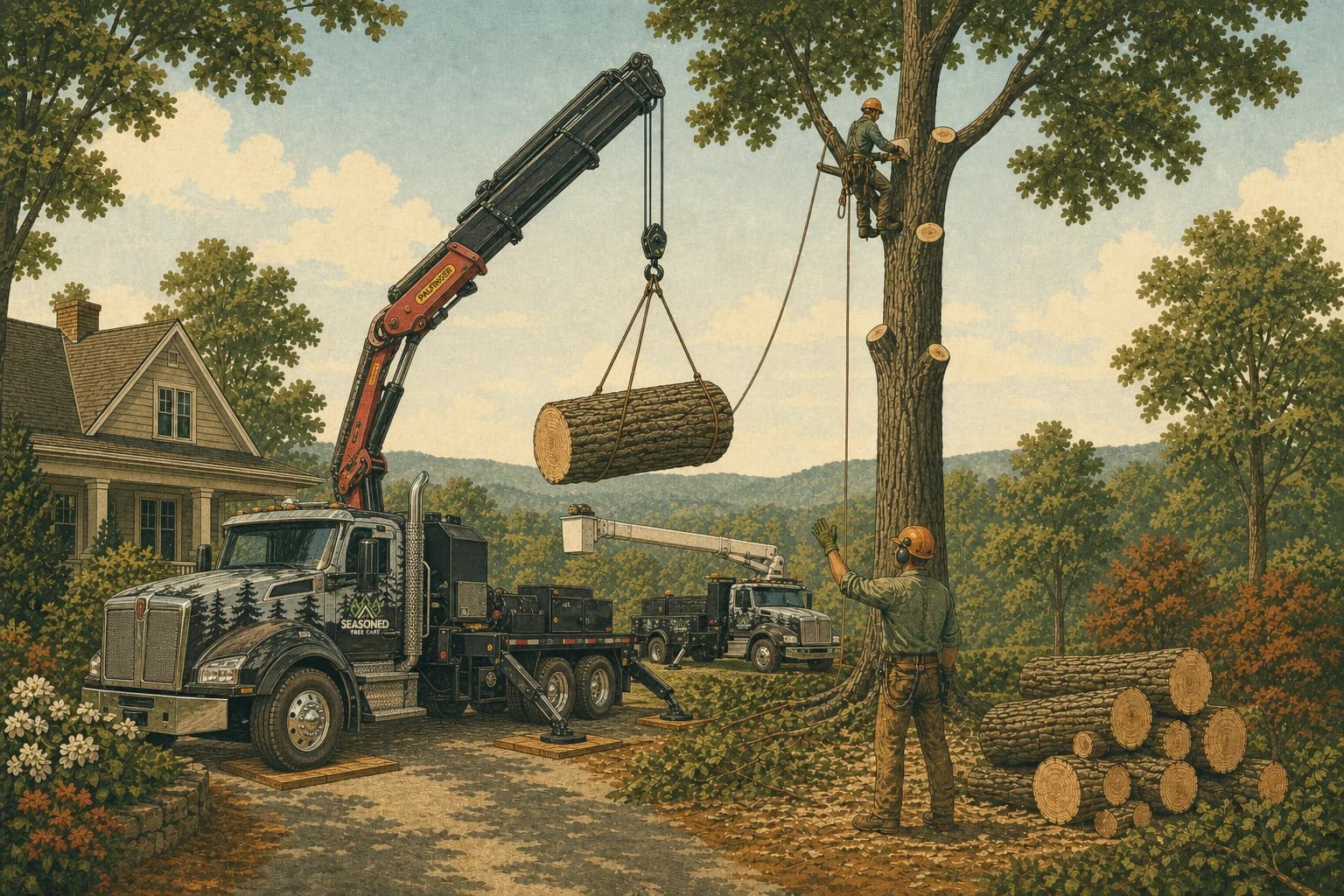
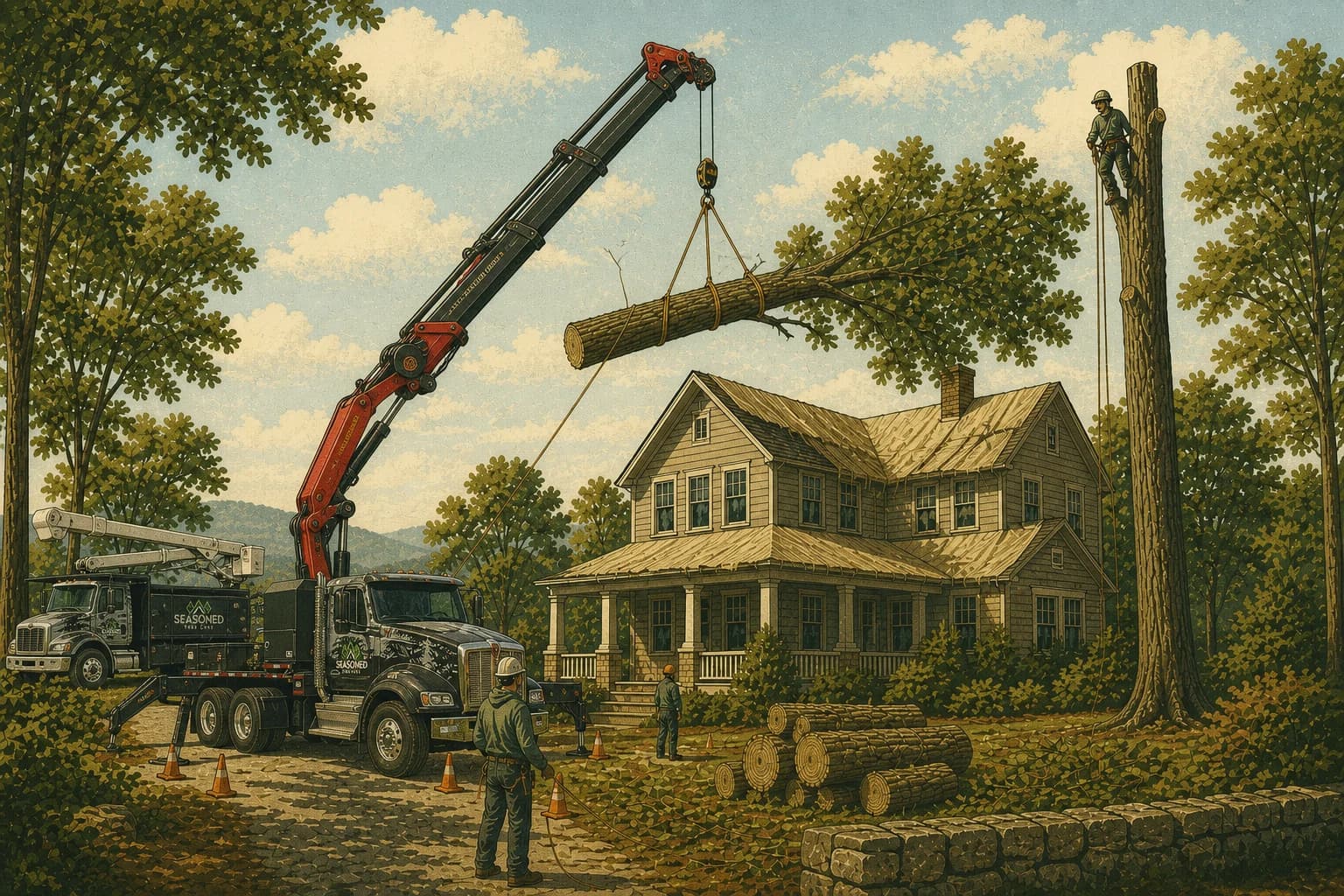
A crane flips that logic. Instead of lowering pieces down over the house, the crane takes up the weight of each section before it is cut, then lifts that section straight up and away from the roof and swings it out to a clear drop zone. The defining principle of crane work is that the load is supported before the wood is severed, so nothing is ever dropped toward the structure. OSHA's tree-care guidance emphasizes pre-planning lifts and keeping people clear of suspended loads — which is exactly how a crane operation is built to run.
Section 03Does your over-house tree need removal, or just monitoring?
Not every tree over a house is a removal. Plenty of large, healthy trees overhang roofs for decades without trouble, and a tree that's simply big isn't automatically a hazard. The goal is to read the tree honestly rather than panic at its size.
Signs that lean toward removal — especially when the tree overhangs the house — include:
- A new or worsening lean, or soil heaving, cracking, or lifting on one side of the base.
- Large dead limbs, or a whole section of canopy with no leaves while the rest leafs out.
- Mushrooms or conks growing from the trunk, root flare, or major branch unions, which can indicate internal decay.
- Cracks, deep cavities, or soft, crumbling wood, particularly where a heavy limb meets the trunk over the roof.
- Significant storm damage — split leaders, hanging limbs, or a partially uprooted root plate.
Signs that may point toward monitoring rather than immediate removal include a tree that is structurally sound and full-canopied, with only minor deadwood that can be pruned, and no movement at the base. Clemson HGIC's guidance on diagnosing tree decline notes that decay, dieback patterns, and root problems often need to be evaluated together rather than judged by any single symptom — which is precisely why a photo can't settle it. We don't diagnose serious risk from a picture; we look in person, check the base and the wood, and give you a straight read on whether the tree should come out now, be pruned, or be watched.
Section 04What a safe over-house crane removal involves
A good over-house removal is almost boring to watch, because the drama has been engineered out of it in advance. The sequence looks like this:
- On-site assessment — we evaluate the tree's species, lean, height, and condition, and identify the roof, utilities, and landscaping the lift has to protect.
- Lift planning — we work out the order of cuts and the weight of each section so the crane is never asked to do more than it should, and so the tree comes apart away from the house.
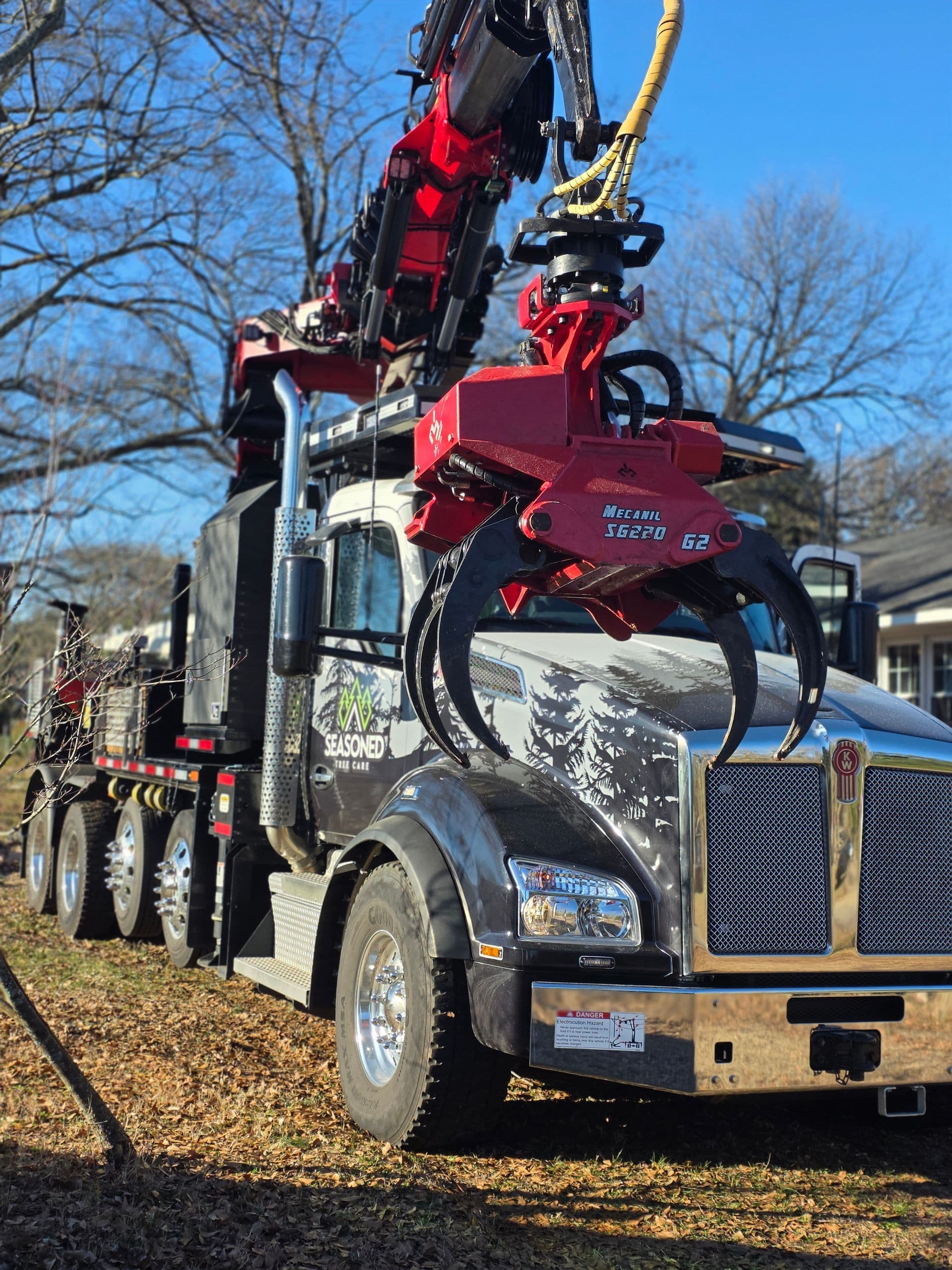
- Crane setup and outriggers — the Palfinger knuckle-boom crane truck is positioned and its outriggers are deployed onto firm, level ground for a stable base under every lift.
- Drop-zone designation — we mark exactly where each section will be set down and keep that zone clear of people for the whole job.
- Turf protection — we lay turf protection mats under and around the equipment to spread the load and reduce rutting and soil compaction.
- Rigging and pre-loading — each section is attached to the crane and its weight is taken up before any cut is made, so the load is fully supported.
- Controlled cuts — the climber makes precise cuts in the planned order while the crane, not the tree, holds the weight; nothing free-falls.
- Lift up and away — the supported section is lifted straight up clear of the roof and swung to the drop zone, then lowered to the ground crew.
- Ground processing — sections are bucked and brush is fed through the chipper; logs are loaded into the dump or grapple truck.
- Cleanup and stump options — debris is hauled off, the work area is raked, and we discuss leaving, flush-cutting, or grinding the stump.
Behind that sequence sits the equipment that makes it possible — the Palfinger knuckle-boom crane and grapple truck, Bandit 21XP and 15XP chippers, chip and dump trucks, a compact spider lift for tight access, and the turf mats above. The crew also carries $2 million in liability insurance plus workers' compensation, so the work happening over your roof is covered.
Section 05Will my homeowners insurance cover it?
This is one of the first questions we hear, and the honest answer is that it depends on your policy and the circumstances — and that we're not insurance advisers. As a general pattern, many policies are more likely to help with removal when a tree has already fallen and damaged a covered structure, while the routine removal of a standing tree, even a large one over the house, is often treated as ordinary maintenance the homeowner pays for. Deductibles, coverage limits, and whether the tree was already dead or neglected can all matter. The right move is to call your insurer, read your policy, and ask specifically about your situation. We can provide written estimates, documentation, and photos, which is typically what a carrier wants to see.
Section 06What it costs — and why a crane can be cheaper
Over-house removals are priced individually, because the same factors that make them dangerous also drive the cost. Tree size and weight, condition, how tight the access is, how close the canopy sits to the roof and utilities, the volume of wood and brush to process, and how you want the stump handled all move the number. The ranges below are hypothetical examples only — not a quote — and exist purely to show how the variables interact. Your actual price comes from a free on-site written estimate.
Mid-size tree over a roof, good access
- Hypothetical example range
- $1,500 - $3,500
Large tree over a house, tight access or decay
- Hypothetical example range
- $3,500 - $7,500
Very large or storm-damaged tree on a structure
- Hypothetical example range
- $7,500+
| Situation | Hypothetical example range |
|---|---|
| Mid-size tree over a roof, good access | $1,500 - $3,500 |
| Large tree over a house, tight access or decay | $3,500 - $7,500 |
| Very large or storm-damaged tree on a structure | $7,500+ |
It surprises many homeowners, but on a big tree over a house a crane is frequently the cheaper path, not the pricier one. The reason is time and risk. Hand-dismantling a large tree above a roof can take a full day or more of climbing and roping each piece down individually, with every hour adding crew cost and another chance for a section to catch a gutter or shingle. A crane can take the same tree apart in a fraction of that time and lift the heavy wood clear of the structure entirely, so fewer hours and far less risk of roof damage often add up to a lower total — even though the machine is bigger.
Section 07Get a straight answer on your tree
A tree over your house is worth a careful, in-person look rather than a guess. If it's healthy and sound, we'll tell you it can be monitored or pruned. If it genuinely needs to come out, we'll lay out whether a crane is the safest, most cost-effective way to do it. You can read more about our dedicated crane tree removal service, see how it fits within standard tree removal, or — if a tree is already down on your home — call on our 24/7 emergency tree service. We serve Anderson, Greenville, and the wider Upstate, and every estimate is free and in writing.
Got a large tree leaning or hanging over your house? Tell us about it and we'll come look — free written estimate, and a straight answer on whether it needs a crane, a climb, or just a watchful eye. Call (864) 762-1253.
See Crane Removal →Quick answers
Frequently asked questions
No. Some trees over a roof can be safely climbed and rigged down piece by piece by a skilled crew, especially when the tree is healthy and there is room to lower sections to one side. A crane becomes the right call when the tree is very large, dead or decayed, leaning hard over the structure, or boxed into a space with no clear lowering zone. We look at each tree and recommend the method that is safest and most cost-effective for that specific situation.
Photos help us understand the scope and decide what equipment to bring, but they cannot replace an on-site assessment. A lot of what determines risk — the firmness of the soil at the base, the sound of the wood, hidden decay where a limb meets the trunk, recent movement in a lean — can only be judged in person. We offer free written estimates, so the honest answer is to have someone walk the property and look.
Not automatically. The equipment setup, access and crew work differ by property. Ask the estimator to explain the proposed method and compare the complete scope, including hauling and stump work. A crane does not guarantee a lower price.
First, get everyone out of the affected part of the house and stay clear of any limbs touching power lines — treat those lines as live and call the utility and 911. Then call a professional crew. We offer 24/7 emergency tree service for exactly this. Do not climb on the roof or try to cut a loaded tree yourself; a tree resting on a structure is under tension and can shift suddenly.
It depends on your policy and what happened. Many policies help with removal when a tree has actually fallen on and damaged a covered structure, while routine removal of a healthy or simply inconvenient tree is usually the homeowner's responsibility. This is general information, not insurance advice — check directly with your insurer and read your policy. We're glad to provide the written documentation and photos most carriers ask for.
Yes. We lay turf protection mats under and around heavy equipment to spread the load and reduce rutting, and we plan the drop zone so cut sections come down in a controlled spot rather than onto your beds or fence. Protecting the property you're keeping is part of the job, not an afterthought.
Related services & areas
Sources & further reading
- OSHA — Tree work safety guidance on planning lifts and keeping workers out from under suspended loads
- ISA / Trees Are Good — Recognizing signs of tree risk and the value of professional assessment before removal
- Clemson HGIC — Guidance on diagnosing tree decline, decay, and storm damage in the landscape
Published by Seasoned Tree Care LLC. Serving Anderson, Greenville & communities across Upstate South Carolina. This article is general information, not a substitute for an on-site assessment.