Start here
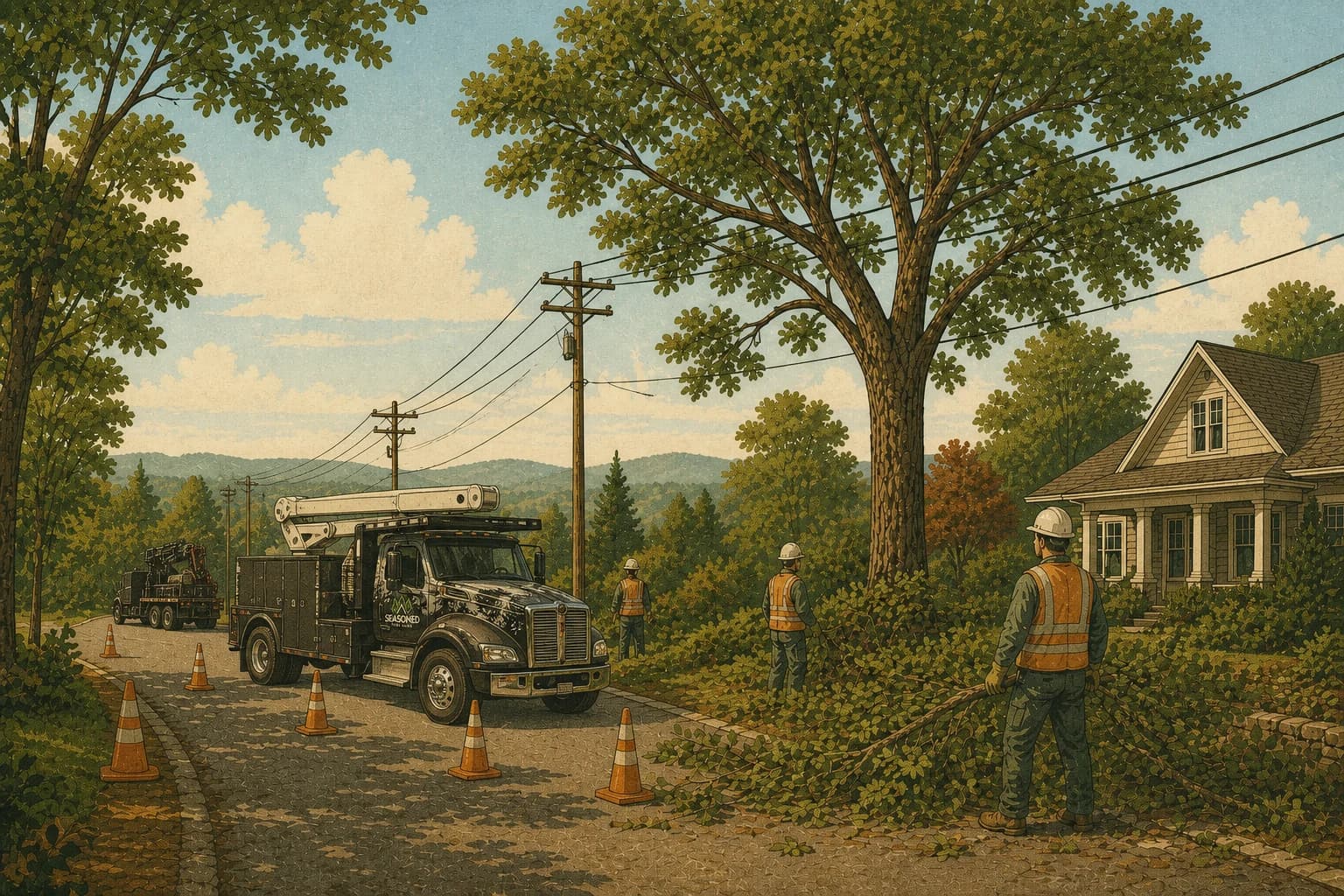
A tree leaning into a power line, a limb resting on a wire after a storm, branches creeping into the lines along the road — these are some of the most dangerous situations a homeowner can face on their own property, and also some of the most common questions we get in Anderson, Greenville, and across the Upstate. The instinct is often to grab a pole saw and deal with it. Please don't. This guide explains what is actually safe, who is responsible for which lines, when to call the utility versus a tree service, and how a professional removal near lines is planned and carried out.
Section 01Why this is a safety issue, not a chore
Electricity doesn't need you to touch the wire to hurt you. It can arc across a gap, travel through a tree, a ladder, a metal pole saw, or wet ground, and it gives no warning. A branch that looks like it's just resting on a line can be energizing the whole tree. OSHA's guidance on electrical and tree-work hazards is blunt about it: stay clear of energized lines, assume downed lines are live, and leave line-area work to qualified people. The International Society of Arboriculture (Trees Are Good) likewise treats work near utility lines as a job for trained professionals, not homeowners. The cost of getting this wrong is not a damaged saw — it is a life.
Section 02Know your zones: which line is which
Not all overhead wires are the same, and who's responsible depends on which one you're looking at. In general terms — and this is general guidance, not legal advice for your specific situation — the lines fall into a few categories:
Transmission lines
- What it is
- High-voltage lines on tall towers or large poles carrying power across the region.
- Who generally handles vegetation
- The utility maintains these and the clearance around them.
Distribution lines
- What it is
- The neighborhood lines along streets that feed local power.
- Who generally handles vegetation
- The utility manages tree clearance in their corridor.
Service drop
- What it is
- The lower line running from the pole to your house.
- Who generally handles vegetation
- Often the homeowner's responsibility for nearby trees — but still not a DIY job near the wire.
Service equipment on the home
- What it is
- The mast, meter, and attachment point on your house.
- Who generally handles vegetation
- Typically the homeowner's responsibility; the utility advises on de-energizing.
| Line / zone | What it is | Who generally handles vegetation |
|---|---|---|
| Transmission lines | High-voltage lines on tall towers or large poles carrying power across the region. | The utility maintains these and the clearance around them. |
| Distribution lines | The neighborhood lines along streets that feed local power. | The utility manages tree clearance in their corridor. |
| Service drop | The lower line running from the pole to your house. | Often the homeowner's responsibility for nearby trees — but still not a DIY job near the wire. |
| Service equipment on the home | The mast, meter, and attachment point on your house. | Typically the homeowner's responsibility; the utility advises on de-energizing. |
The practical takeaway: even where a tree near your service drop is technically your responsibility, that does not make it safe to handle near the wire. Your utility can confirm exactly where their responsibility ends and yours begins for your specific connection — and they would much rather get that call than respond to an accident.
Section 03When to call the utility vs. a tree service
Knowing who to call first saves time and keeps everyone safe. Use these quick lists as a guide.
Call your electric utility (or 911) first when:
- A tree or branch is touching, resting on, or tangled in any power line.
- A line is down on the ground, in a tree, or across a driveway or road.
- You see sparking, arcing, smoke, or fire near a line — call 911 immediately.
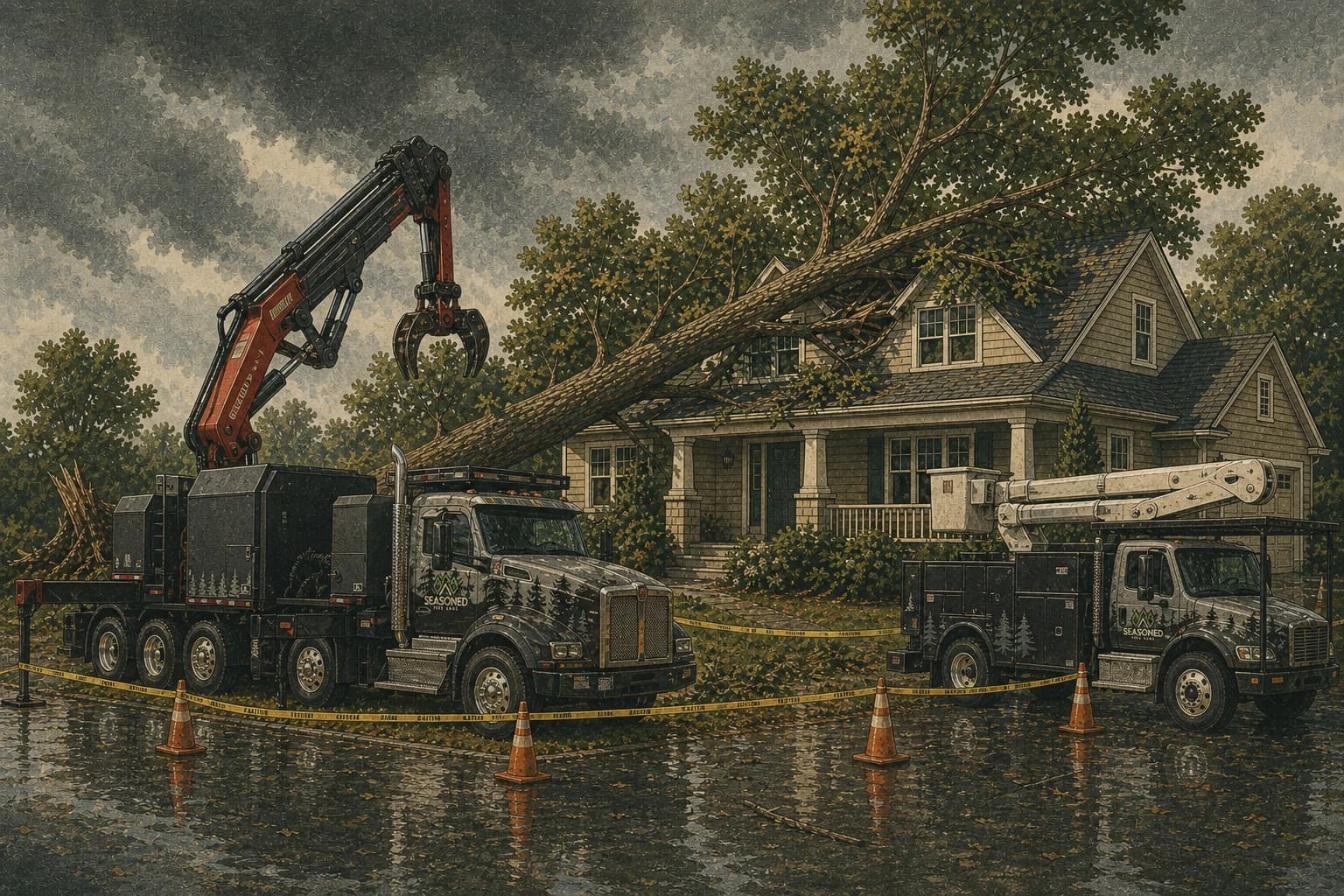
- A storm has dropped a tree onto lines and the power is out in the area.
- Branches are growing into the utility's distribution lines along the street.
- You're unsure whether a wire near a tree is energized — assume it is and call.
Call a tree service like Seasoned Tree Care when:
- A tree near lines is leaning, dead, or structurally failing and needs removal.
- The utility has made the line area safe and the tree itself needs to come down.
- A storm-damaged tree on your property needs a coordinated, professional removal.
- You want a free estimate and a hazard assessment of a tree growing near lines.
- You need a removal planned around lines that requires a crane, spider lift, and utility coordination.
Section 04Why removals near lines need pros and the right equipment
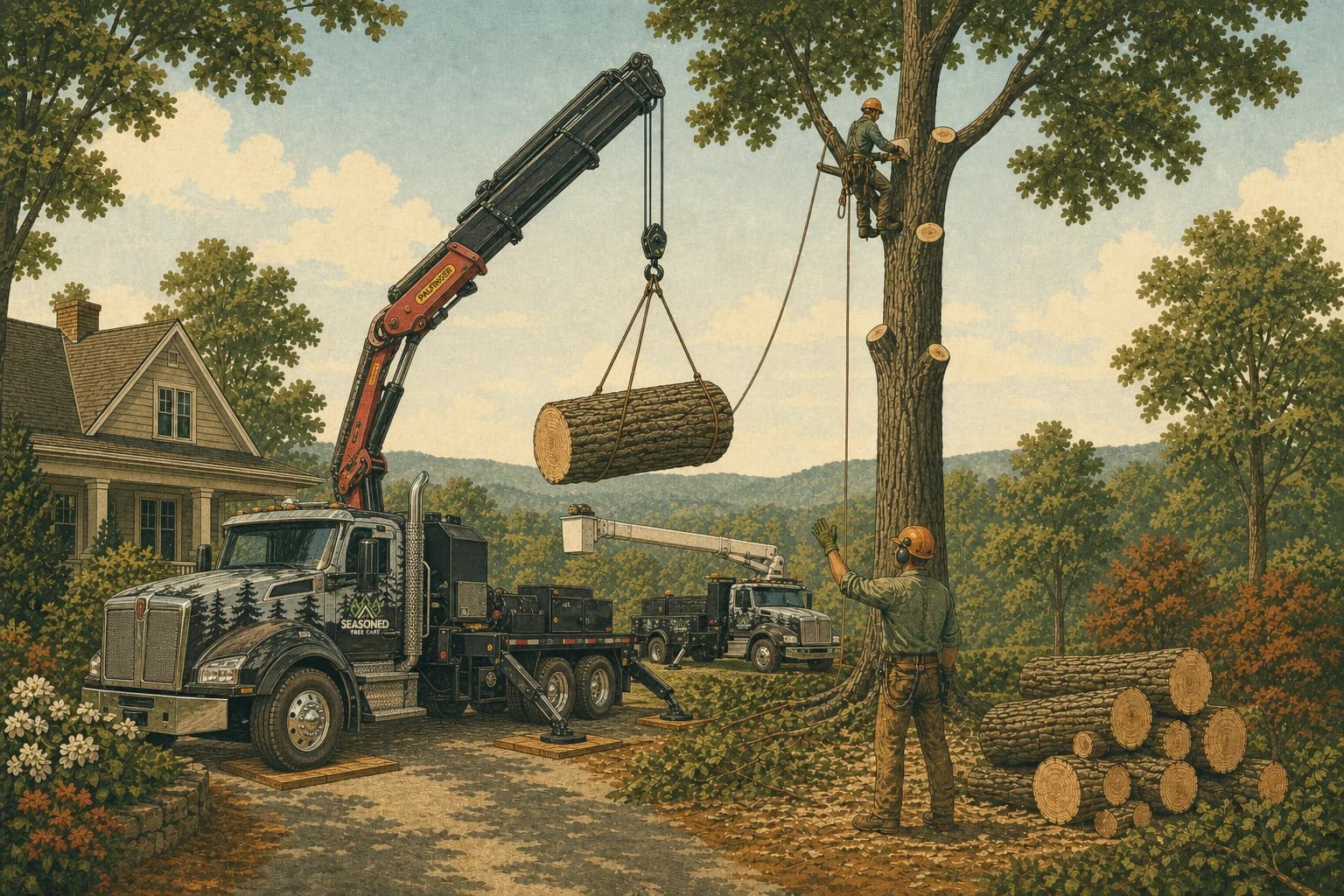
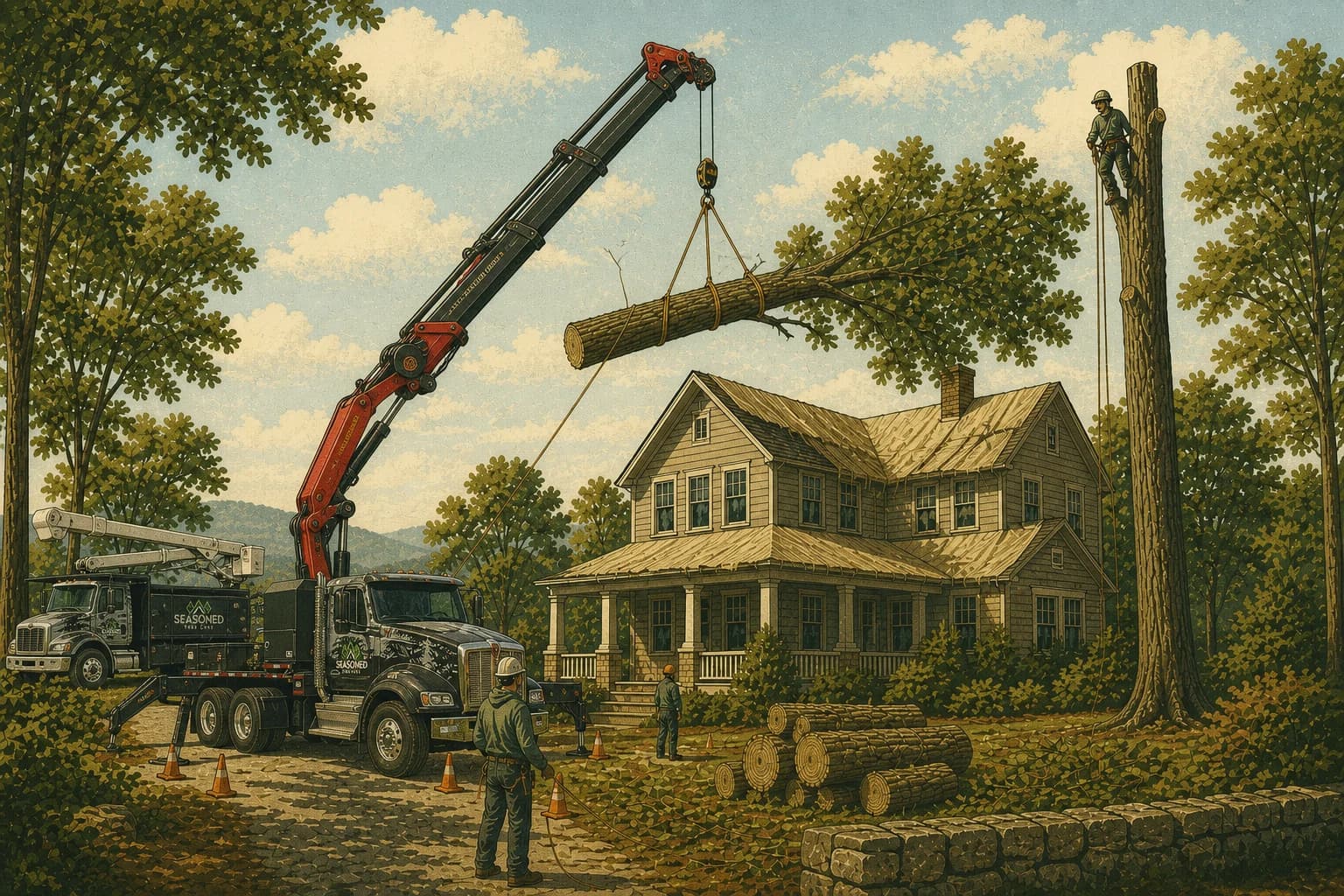
Removing a tree near power lines is one of the hardest things in tree work, because the margin for error is so small and the consequences are so severe. The right equipment exists specifically to keep crews out of the danger zone. A Palfinger crane lets the crew lift cut sections straight up and away from the lines, so nobody is working into the line corridor and no piece is dropped where it could swing toward a wire. A spider lift can position a crew member precisely without the climber having to work through the canopy near the lines. A grapple truck moves heavy wood without dragging it across the yard, and turf protection mats keep the lawn intact while the equipment is set up. None of this replaces the utility's role with the line itself — but it's what makes the tree work safe once the line is handled.
Section 05How a professional removal near lines is planned
A safe removal near power lines follows a disciplined sequence. The planning is the job; the cutting is the easy part.
- Assessment — we evaluate the tree's species, lean, condition, and exactly where it sits relative to each line, identifying the hazards before anyone touches it.
- Utility coordination — when lines are in or near the work zone, we coordinate with the utility, which may need to de-energize, drop, or protect a line before work proceeds.
- Setup and access — the crane truck is positioned on stable, level ground with outriggers deployed, and turf mats are laid to protect the lawn.
- Drop-zone planning — we designate exactly where each cut section will be set down, well clear of the lines and of any people.
- Controlled cuts — sections are rigged and supported by the crane before they're cut, so the crane controls the weight and nothing free-falls toward a line.
- Lift and removal — supported sections are lifted straight up and away from the line corridor, then lowered to the ground crew for processing.
- Cleanup — wood and brush are processed and hauled, and the work area is raked and cleared.
Section 06Signs a tree near lines is becoming a hazard
The best time to deal with a tree near power lines is before a storm makes the decision for you. Watch for these warning signs and get a professional look if you see them:
- A developing lean toward the lines, or a lean that seems to be getting worse.
- Dead, hanging, or broken limbs — especially any positioned over or near a line.
- Large dead sections in the canopy, or a canopy that's thinning on one side.
- Cracks or splits at the trunk or where major limbs join.
- Heaving soil, exposed roots, or a tree that shifts in wind at the base.
- Branches that have grown into, or are crowding, the line corridor.
Clemson HGIC's planting guidance points out that a lot of these conflicts start at planting — putting the wrong tree under or beside a line means decades of pruning battles and growing risk. For a tree that's already there and already near the lines, the right move is an assessment, not a wait-and-see.
Section 07What to do right now
If a tree or branch is touching a line, stop reading and call your electric utility — and 911 if anything is down, sparking, or burning. If a tree near lines is leaning, dead, or growing into the corridor but nothing is in contact with a wire yet, that's exactly the situation to have assessed before it becomes an emergency. We coordinate with the utility, bring the crane and lift to keep the work out of the danger zone, and respond 24/7 when a tree has already come down. Estimates are free, and the work is backed by $2 million in liability insurance plus workers' compensation.
Learn more about our crane tree removal for jobs that need the load lifted clear of the lines, our standard tree removal service, and our 24/7 emergency tree service for trees that have already fallen.
Worried about a tree near your power lines in Anderson, Greenville, or the wider Upstate? Call (864) 762-1253 or request a free estimate — and if a line is involved, call your utility (and 911 for emergencies) first.
Emergency Tree Service →Quick answers
Frequently asked questions
Call your electric utility first. The line is their equipment, and only they can de-energize it or clear it safely. Do not approach the branch, do not try to knock it off, and do not let anyone — including pets and children — get near it. If the line is down, arcing, sparking, smoking, or has started a fire, call 911 immediately and keep everyone far back. A tree service like ours can plan and carry out the removal of the tree itself, but only once the utility has made the line area safe and the work falls within our scope.
No reputable company trims or cuts a branch that is in contact with an energized line. That work belongs to the utility or to specially trained line-clearance crews working under the utility's control, with the line protected or de-energized. We coordinate with the utility, stay clear of the lines, and handle the parts of the job that are safe and within our scope. Anyone who offers to casually 'just snip' a branch off a live line is putting your property and lives at risk.
It depends on the line. As a general rule (not legal advice), the utility maintains its transmission and distribution lines and the vegetation around them, while the homeowner is typically responsible for trees that threaten the service drop running to the house and for the equipment on the home itself. Even where a tree near the service drop is your responsibility, that does not mean it's safe to DIY near it. Your utility can confirm exactly where their responsibility ends and yours begins for your specific connection.
A crane lets the crew lift cut sections straight up and away from the work area instead of working into the line corridor or dropping pieces that could swing toward a line. When a tree is large, leaning toward lines, or boxed into a tight space, the crane keeps the load controlled and the crew's exposure low. The line clearance itself is still coordinated with the utility — the crane handles the tree, not the wire.
Treat every downed line as live and deadly, even if it looks dead and isn't sparking. Stay at least the length of a tree away, keep others back, and call your utility and 911. Do not drive over downed lines and do not step near water that may be in contact with them. Once the utility has secured the scene, our 24/7 emergency crew can remove the tree. We carry $2 million in liability insurance plus workers' compensation, so the work on your property is covered.
Watch for a developing lean toward the lines, dead or hanging limbs, large dead sections in the canopy, cracks at the trunk or major limbs, heaving soil or exposed roots at the base, and branches that have grown into or are crowding the line corridor. Any of these near a power line is worth a professional look before a storm forces the issue. We offer free estimates, so an assessment costs you nothing.
Related services & areas
Sources & further reading
- OSHA — Electrical and tree-work hazards, including keeping clear of energized lines and treating downed lines as live
- ISA / Trees Are Good — Why line-clearance and tree work near utilities should be left to qualified professionals
- Clemson HGIC — Guidance on selecting and placing trees so they don't grow into utility line corridors
Published by Seasoned Tree Care LLC. Serving Anderson, Greenville & communities across Upstate South Carolina. This article is general information, not a substitute for an on-site assessment.