Start here
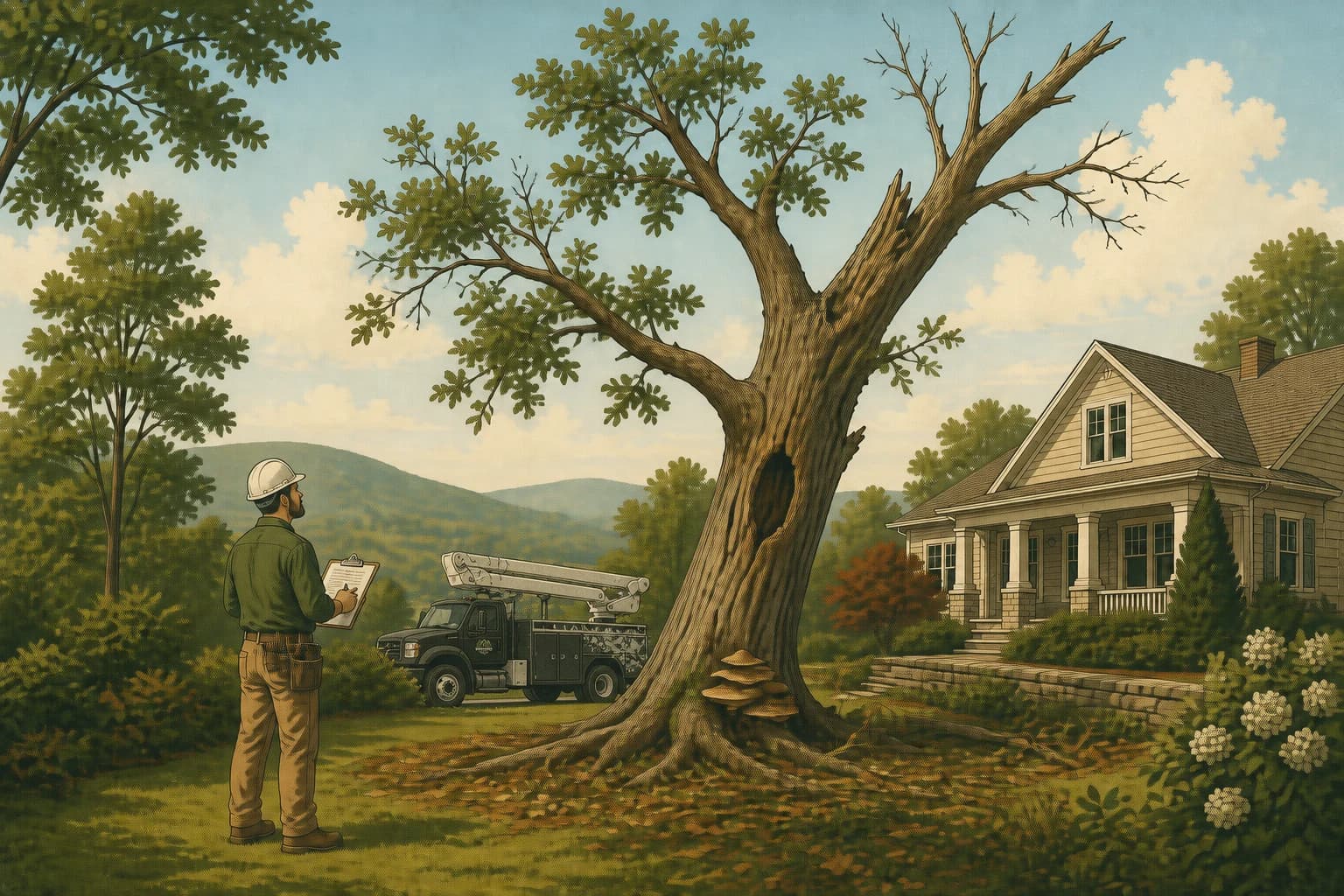
Not every troubled tree needs to come down. A tree can look rough and still be perfectly stable, or it can look fine from the street and hide a serious problem at the roots. The goal of this guide is to help you read your tree honestly — to know which warning signs are worth attention, which are genuinely urgent, and when something less drastic than removal might be the right call.
A quick word of caution before we start. The signs below are reasons to look closer, not automatic verdicts. The International Society of Arboriculture, through its Trees Are Good resources, stresses that judging a tree's risk depends on its condition, its structure, and what's nearby — context that a homeowner can begin to observe but that a trained eye should confirm on site.
Section 011. A new or worsening lean with heaved or cracked soil
A lean by itself is rarely the whole story. Many healthy trees lean toward light or grew crooked from the start and have been stable that way for years. What changes the picture is movement — a lean that is new, or one that is clearly getting worse over time.
What you can safely observe: walk to the base and look at the soil on the side away from the lean. Soil that is mounded, lifted, or cracked, or roots that appear to be pulling up, can mean the root plate is starting to fail. You can also note whether the lean looks different than it did last year, using an old photo if you have one.
When it's urgent: a sudden new lean after a storm, or visible soil heaving at the base, is a reason to keep people and vehicles clear and call for a prompt assessment. When it may be something else: a long-standing, unchanged lean on an otherwise healthy tree is often stable, and in some cases structural support such as cabling or selective pruning to reduce weight can be considered instead of removal.
Section 022. Large dead limbs or canopy dieback over about a quarter of the tree
Some deadwood is normal in any mature tree. The concern is scale and location. Widespread dieback — roughly a quarter or more of the canopy dead — suggests the tree is under real stress, and large dead limbs poised over a roof, driveway, or play area are a hazard regardless of the tree's overall health.
What you can safely observe: in the growing season, look for whole sections that never leafed out, bare branches against a full canopy, or brittle limbs with no buds. Clemson Cooperative Extension's HGIC resources describe how progressive dieback and thinning foliage are signals of decline that deserve a closer look at the cause.
When it's urgent: large dead limbs above something you care about should be addressed before they fall on their own. When it may be something else: scattered deadwood, or dieback from a treatable cause, can sometimes be handled by removing the dead wood through pruning while the tree is monitored, rather than removing the whole tree.
Section 033. Cracks, splits, or cavities in the trunk or a main fork
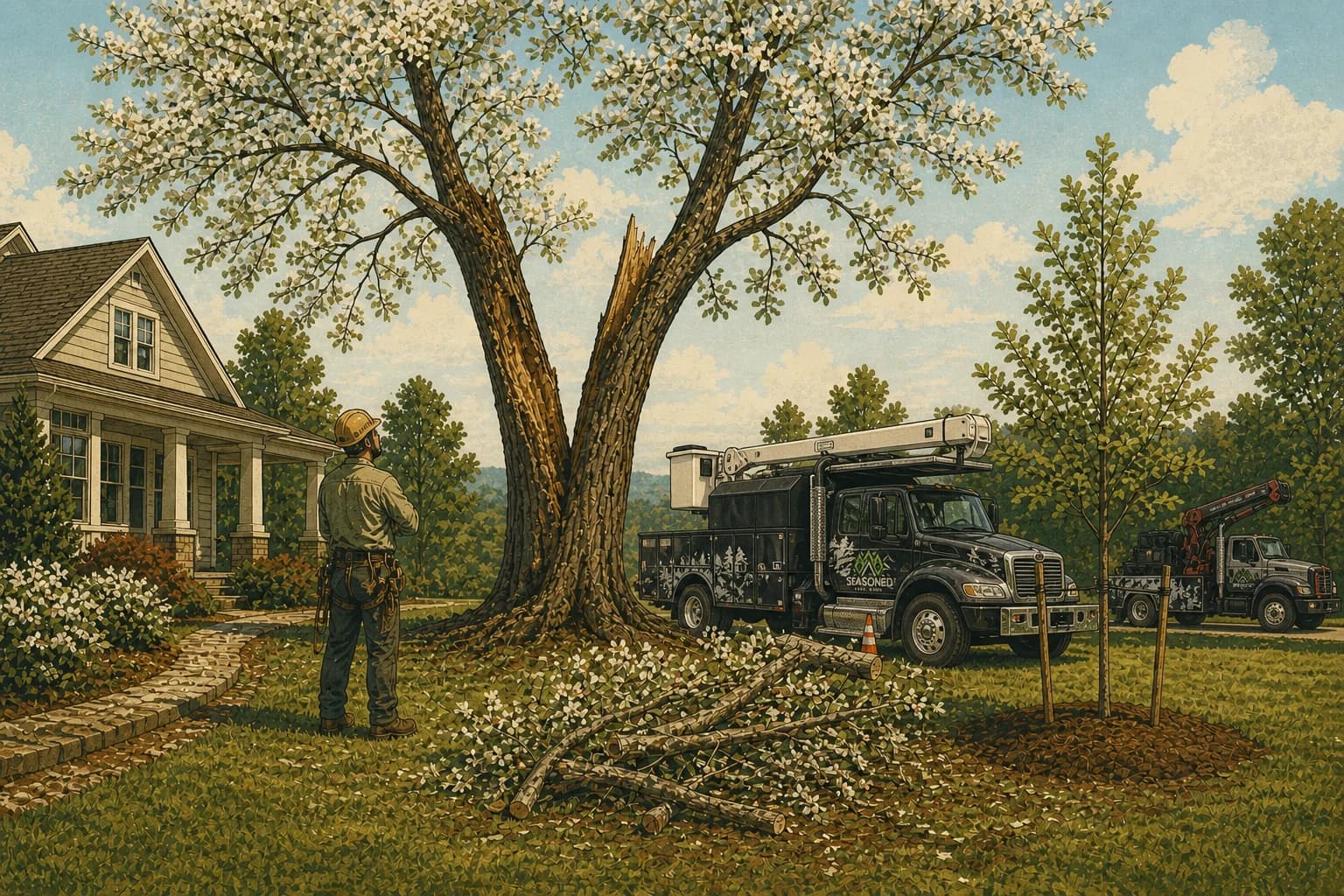
The trunk and the major unions where big limbs meet are the structural backbone of a tree. Defects there matter more than the same flaw out on a small branch. Vertical cracks, seams that open and close, and tight V-shaped forks with included bark are all places where a tree can fail under load.
What you can safely observe: look for deep cracks running up the trunk, splits where two large stems join, open cavities, or bark that is missing over a large area. A fork that looks more like a tight V than a rounded U, especially on a heavy double-stemmed tree, is worth noting.
When it's urgent: a fresh split through a main fork, or a large open crack on a big tree near a structure, calls for prompt professional attention. When it may be something else: smaller cavities that have callused over, or weak unions caught early, can sometimes be managed with cabling, bracing, or weight-reducing pruning rather than removal — a judgment best made in person.
Section 044. Mushrooms, conks, or soft decayed wood at the base
Fungi feeding on a tree's wood are one of the more serious warning signs precisely because the damage is hidden. Decay in the roots or lower trunk can hollow out the very wood the tree relies on to stand, often with little outward change until structure is already compromised.
What you can safely observe: look at the root flare and lower trunk for mushrooms, hard shelf-like brackets (conks), or wood that is soft, crumbly, or sunken when you press near it. Clemson's HGIC resources note that wood-decay fungi appearing on the trunk or root flare are a meaningful sign of internal decay.
When it's urgent: conks combined with a large tree leaning toward a house point strongly toward assessment, since root or butt rot can lead to whole-tree failure. When it may be something else: not every fungus signals fatal decay, and the only way to gauge how far it has gone is an evaluation that may include checking the extent of the affected wood — so this is a sign to have looked at rather than to ignore or to act on rashly.
Section 055. Root damage from construction, trenching, or driveway work
Roots are out of sight, so the harm done to them is easy to overlook — yet they anchor the tree and feed it. Trenching for utilities, regrading, a new driveway or patio, or heavy equipment compacting the soil over the root zone can injure roots that won't show symptoms in the canopy for a season or more.
What you can safely observe: think back on any digging, paving, or grade changes within the root zone over the past few years. Then watch for delayed signs above ground — thinning leaves, smaller-than-usual foliage, dieback at the top, or a tree that suddenly seems less stable in wind.
When it's urgent: major root severing on the side of a large tree, paired with any new lean, is a stability concern worth a prompt look. When it may be something else: lesser root disturbance is sometimes survivable with supportive care — appropriate watering, mulching, and monitoring over time — and removal becomes the answer only if decline and instability progress.
Section 066. Close proximity to a foundation, structure, or power lines
Sometimes the issue isn't the tree's health but where it stands. A sound tree growing tight against a foundation, crowding a roof, or pushing into utility lines can still warrant action because of what it threatens or what could happen if any part of it fails.
What you can safely observe: note how close the trunk and major limbs are to the house, garage, septic field, or overhead lines, and whether the tree's likely growth will worsen the conflict. Never approach or attempt to clear branches near power lines yourself — that is hazardous and is utility or professional work.
When it's urgent: contact with power lines or limbs resting on a roof needs to be handled by professionals, not a ladder and a saw. When it may be something else: many proximity problems are solved short of removal — directional pruning, crown reduction, or clearance work can resolve a conflict while keeping a healthy tree, with removal reserved for cases where the tree simply cannot coexist with the structure.
Section 077. Repeated limb drops or storm damage year after year
A pattern tells you more than a single event. A tree that drops sizable limbs in routine weather, or takes significant storm damage season after season, may have underlying structural weakness rather than simple bad luck.
What you can safely observe: keep a mental or written tally. Has this tree shed large limbs more than once? Does it lose wood in storms that leave neighboring trees intact? Recurring failure of major limbs is different from the occasional small branch coming down in a gale.
When it's urgent: a tree that keeps shedding heavy limbs over a driveway, deck, or roofline is an ongoing hazard worth resolving rather than reacting to each time. When it may be something else: a history of failures sometimes traces to correctable structure, where a program of pruning and cabling can reduce risk — though a tree with a long record of major failures near targets is often a strong candidate for removal.
Section 08Removal is one option among several
It's worth repeating that a warning sign is the start of a conversation, not the end of one. Depending on what an inspection finds, the right answer might be targeted pruning to take out deadwood or reduce weight, structural support such as cabling or bracing, clearance work near a structure or line, or simply scheduled monitoring so changes get caught early. Our tree trimming service covers much of that middle ground between doing nothing and removing a tree.
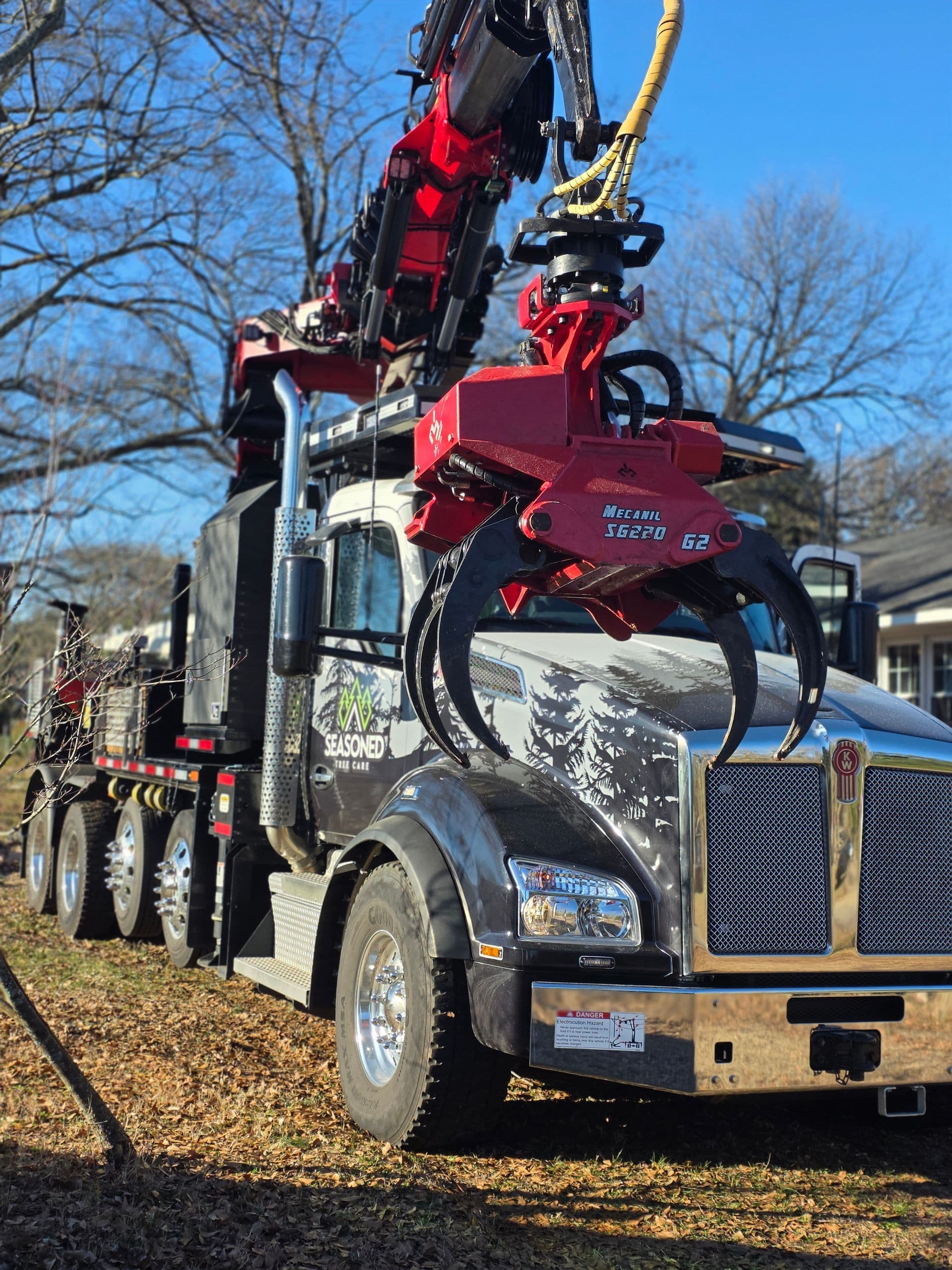
When removal genuinely is the safest path — an unstable, heavily decayed, or hazardous tree near a home — it can often be done cleanly. For large trees over a house, pool, or tight access, our crane tree removal approach lets sections be lifted out rather than dropped, and our tree removal page walks through how the work is planned. The point is to match the action to the tree, not to default to the chainsaw.
Seeing one or more of these signs on a tree near your home in Anderson, Greenville, or the Upstate? The honest next step is to have it looked at in person, before deciding anything.
Get a Free Assessment →Seasoned Tree Care serves Anderson, Greenville, and the surrounding Upstate from our base in Honea Path, South Carolina. If a tree on your property is leaning, dropping limbs, showing decay, or simply giving you a bad feeling, call (864) 762-1253 and we'll come take a careful look — and tell you straight whether it needs to come down or can be saved.
Quick answers
Frequently asked questions
No. Many trees grow with a natural lean and stand for decades. What raises concern is a new or worsening lean, especially when paired with cracked or heaved soil on the side opposite the lean, which can signal that roots are failing. A sudden change after a storm is worth a prompt professional look; a long-standing, stable lean usually is not an emergency.
Not reliably. Photos can flag things worth checking, but they can't show root condition, the depth of internal decay, soil movement, or how the tree behaves in wind. A sound judgment about removal versus pruning, cabling, or monitoring comes from an on-site assessment where someone can inspect the base, the trunk, the canopy, and the surroundings together.
There's no single rule, but widespread dieback — roughly a quarter or more of the canopy dead, or large dead limbs over targets like a house or driveway — is a sign the tree is under serious stress. Some trees recover with care; others are declining. An assessment helps tell the difference between dead limbs that can be pruned and a tree that should come down.
They can be. Mushrooms or hard shelf-like conks growing on the root flare or lower trunk often indicate fungal decay in the wood that supports the tree. Because that decay isn't visible from the outside, it's one of the signs that most warrants a professional evaluation rather than a wait-and-see approach.
Usually not on the strength of a single sign alone. One symptom often has a manageable explanation, and alternatives like targeted pruning, cabling, or scheduled monitoring may apply. It's the combination of several signs — particularly on a large tree close to a house, driveway, or power line — that most strongly points toward getting a professional assessment soon.
Related services & areas
Sources & further reading
- ISA / Trees Are Good — Recognizing tree decline, structural defects, and the value of professional assessment
- Clemson Cooperative Extension HGIC — Diagnosing tree decline, decay fungi, and common landscape tree problems in South Carolina
- SC Forestry Commission — South Carolina forest and tree health resources
Published by Seasoned Tree Care LLC. Serving Anderson, Greenville & communities across Upstate South Carolina. This article is general information, not a substitute for an on-site assessment.