Start here
There is no single month when every tree in Greenville, Anderson and the Upstate should be pruned. The useful starting questions are which species you have, why work is needed and whether there is damage that changes the urgency. Use the seasonal guide below to plan an assessment, then match the pruning to the actual tree.
Section 01A seasonal starting point
Many shade trees not grown for flowers
- Planning window
- Often late winter or early spring.
- What to verify
- Species, condition and the reason for pruning.
Spring-flowering dogwood or redbud
- Planning window
- After flowering when preserving blooms matters.
- What to verify
- Pruning before bloom can remove flower buds.
Summer-flowering crape myrtle
- Planning window
- Late winter, if pruning is needed.
- What to verify
- Avoid arbitrary topping; consider mature size and natural form.
Broken, hanging or hazardous limbs
- Planning window
- Prompt assessment when the problem is discovered.
- What to verify
- Urgency, the work area and a safe method; do not wait just for a preferred month.
Diseased or declining trees
- Planning window
- Diagnosis before choosing timing or cuts.
- What to verify
- The cause may change the treatment or whether pruning is appropriate.
| Tree or situation | Planning window | What to verify |
|---|---|---|
| Many shade trees not grown for flowers | Often late winter or early spring. | Species, condition and the reason for pruning. |
| Spring-flowering dogwood or redbud | After flowering when preserving blooms matters. | Pruning before bloom can remove flower buds. |
| Summer-flowering crape myrtle | Late winter, if pruning is needed. | Avoid arbitrary topping; consider mature size and natural form. |
| Broken, hanging or hazardous limbs | Prompt assessment when the problem is discovered. | Urgency, the work area and a safe method; do not wait just for a preferred month. |
| Diseased or declining trees | Diagnosis before choosing timing or cuts. | The cause may change the treatment or whether pruning is appropriate. |
Clemson explains that flowering time changes pruning timing and that late-season pruning can encourage vulnerable new growth. It also notes that sap bleeding from some pruning cuts is not, by itself, proof of harm. These distinctions are why a species-aware plan is more useful than scheduling every tree for the same treatment.
Section 02Choose the pruning goal before choosing the date
- House or driveway clearance: identify the obstruction and the desired clearance, then evaluate suitable cuts.
- Deadwood or damaged branches: identify the affected tree and the urgency of the condition.
- Young-tree structure: ask about developing a useful structure over time rather than removing too much at once.
- Crowded or crossing growth: ask what selective work is justified for this tree.
- Flowering or appearance: identify the species and how the work could affect bloom and natural form.
Section 03What a local pruning scope looks like
Past work, summarized from completed jobs with paid invoices. Customer names and street addresses are omitted. Descriptions reflect the recorded scope; they are not independent condition reports.
Completed September 2025
Tree removal and roof clearance pruning
Work at this Greenville property included Japanese maple and ginkgo removal, oak pruning for clearance from the house, and pecan pruning near the garage roof. The job also included stump grinding.
Roof clearance, tree removal and stump grinding can be planned together, with a separate description of the work on each tree.
See the local project report →Completed November 2025
Poplar removal and pruning around a play area
This Piedmont job included removing a large poplar near a play area and hauling its debris. Pruning on nearby maples addressed broken hanging branches and deadwood. Additional work included cedar clearance above a fence and removing a hanging cherry branch.
Point out play areas, fences and the trees you want to keep during the estimate so removal and pruning can be planned together.
See the local project report →The recorded Greenville work addressed clearance from a house and garage while removing other trees. The Piedmont scope addressed broken branches, deadwood and clearance near a play area and fence. The completion months describe when those jobs were recorded; they are not recommendations that every tree with those species should be pruned in the same month.
Section 04When not to wait for a preferred season
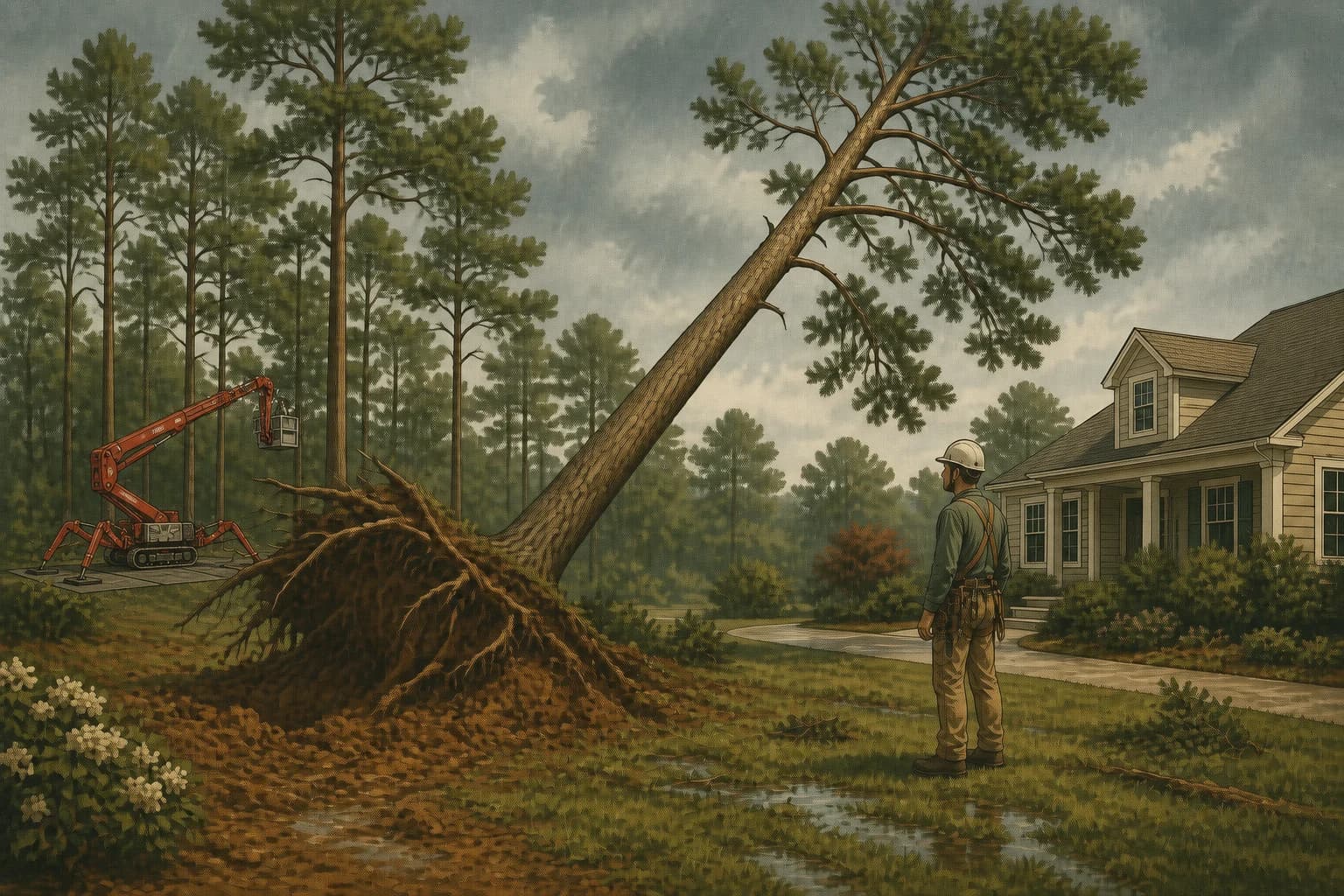
If a limb is hanging, a tree has newly shifted or damage threatens an occupied area, keep people away and arrange a prompt assessment. Do not go under the canopy to investigate a suspended branch. If lines are involved, stay clear and contact the utility or emergency services as appropriate. Our storm-damage guide helps organize the first decisions after a storm.
For routine work, explain your schedule and ask what timing makes sense for the tree. For urgent work, explain the observed problem from a safe location. The crew can then separate immediate needs from care that can be planned later.
Section 05Avoid ordering a percentage of every canopy
A generic request to “thin everything” skips the questions that matter. Two oaks on the same property may have different needs: one may have a dead limb, another may need limited roof clearance, and a third may not need pruning now. The estimate should name the tree, purpose and scope. Do not use a past job’s specified percentage or clearance as a standard for unrelated trees.
If a large tree must be repeatedly cut back to fit beside a building or beneath an overhead restriction, discuss the long-term options. Our tree planting guide can help choose a better future fit when replacement is appropriate. Healthy mature trees should be evaluated before assuming removal is needed.
Section 06Budget and schedule the complete job
Ask whether the pruning estimate includes debris hauling, which trees are included and how equipment reaches them. Our Greenville tree-trimming cost guide separates real invoice examples from general planning guidance. A job that combines removals and pruning needs clear line items so you can understand both the care and the cost.
- Make a list of trees and the observed reason for work.
- Send safe-distance photos of the canopy and surrounding access if requested.
- Have the species, condition and suitable timing assessed.
- Confirm the written pruning scope and debris finish.
- Keep the scope for future care; do not assume an identical treatment is needed every year.
Plan the right pruning for your trees and your property.
Get a written estimate →Quick answers
Frequently asked questions
There is no universal month. Late winter or early spring is a common window for many shade trees; flowering trees and specific conditions can change the timing. Have the species and purpose assessed.
If preserving spring flowers is the goal, routine pruning is generally planned after flowering. Damage or disease may change the priority, so assess the individual tree.
No. Keep people out of the area and arrange a prompt assessment. A preferred season for routine pruning does not make a damaged hanging limb safe to leave above an occupied area.
No. The need depends on species, age, condition, structure and clearance. A useful assessment may recommend limited work, staged care or no pruning at that time.
Related services & areas
Sources & further reading
- Clemson Cooperative Extension — Flowering, seasonal timing and pruning principles
Published by Seasoned Tree Care LLC. Serving Anderson, Greenville & communities across Upstate South Carolina. This article is general information, not a substitute for an on-site assessment.